
What Makes Capitalism Tick?
By Arnold Kling
Understanding the market process as a systematic, error-corrective sequence of profit-inspired entrepreneurial discoveries, continually reshuffled and redirected as a result of the ceaseless impact of exogenous changes, should drastically alter our appreciation of key features of capitalism.
—Israel M. Kirzner, Competition, Economic Planning, and the Knowledge Problem
This volume of the collected works of Israel M. Kirzner, edited with a modestly brief introduction by Peter J. Boettke and Frederic Sautet, addresses deep and important questions that most economists would rather skip. These pertain to what distinguishes market activity from central planning, the economic role of entrepreneurs, and what is meant by competition.

I found the conceptual issues that Kirzner raises to be intellectually challenging, and so I imagine that many readers will as well. If you pick up the book, I recommend starting near the back with the essay “How Markets Work: Disequilibrium, Entrepreneurship, and Discovery,” in order to get a general overview before you tackle the essays from the beginning.
Here, I will focus primarily on the question of what distinguishes a market economy from a centrally planned economy. While my discussion is informed by Kirzner’s writing, I do not claim to completely understand or share his views.
In a market economy, decisions about what to produce and how to produce are made by individual entrepreneurs. In order for entrepreneurs to do this in a way that promotes more efficient economic outcomes:
1. They must be guided by a profit incentive.
2. They must compete in a never-ending process in which they correct mistakes and seize opportunities for improvement.
Many economists believe that the main weakness of socialism is the absence of a profit incentive. But Kirzner writes,
Our further exploration of the interface between the economics of socialist calculation and the economics of the process of entrepreneurial competition will permit us to argue, I believe, that there are analytical grounds for maintaining that the Misesian “problem of knowledge” is indeed anterior to [the] problem of motivation. (page 151)
The problem of knowledge is to discover what consumers want and how to efficiently provide for those wants. Entrepreneurial competition is a process for making such discoveries. In the absence of such competition, the central planner must rely on guesswork.
In a socialist economy, the planner lacks a means for obtaining information on what individuals want. Kirzner point out that, conversely, a market economy has no concept of what “society” wants.
A market economy is by definition made up of a multitude of independently-made individual decisions. In such a context to talk of decisions made “by society” is, at best, to engage in metaphor. “Society” does not, as a simple matter of fact, choose; it does not plan; it does not engage in the “allocation of resources”; it does not have ends; it does not have means; to talk of society facing “its” allocative, economizing problem is, strictly speaking, to talk nonsense. (pages 153-154)
Those of us who wish to defend both methodological individualism and markets are faced with a paradox. When we say that the economy works well, we are claiming to speak for the entire society. But as individualists, we would say that there is no such moral entity as “society.”
My way of dealing with the paradox is to say that I have my intuition about what constitutes a “good economic outcome for society,” and you have yours. If our intuitions have little or nothing in common, then we have no basis for further discussion. But if our intuitions are similar, then we can have a productive dialogue about what sort of institutional arrangements are likely to produce desirable outcomes relative to our respective intuitions.
“For background on these topics, see Socialism,, by Robert Heilbroner; Austrian School of Economics,, by Peter J. Boettke; and the biography of Leon Walras in the Concise Encyclopedia of Economics.
For more writings by Israel Kirzner, The Economic Point of View and Edwin G. Dolan (ed), The Foundations of Modern Austrian Economics.”
During the “socialist calculation debate,” economists who advocated socialism conceded that the price mechanism performs an essential information-processing function. They suggested, however, that a government bureau (today we would say a powerful computer) could store a list of all of the economy’s inputs and outputs. Call this the WAC, for Walrasian-Auctioneer Computer. The WAC would then propose a set of prices for inputs and outputs. Consumers would decide on their demands, and firms would decide on outputs. The WAC would look at the results to see what shortages or surpluses emerged. For inputs or outputs that are in surplus, the WAC would adjust prices downward. For inputs and outputs that are in shortage, the WAC would adjust prices upward. Then it would allow consumers and firms to respond to this new set of prices, and look at those results. This process would continue until all surpluses and shortages were eliminated.
In fact, the process just described is problematic, because the economic activity that takes place at “false prices” in one iteration might alter the desired activity at a subsequent iteration. It by no means guarantees smooth convergence to the point where all markets are in balance.
An alternative is to have the WAC announce a set of prices but not allow trading to take place. Instead, the WAC asks everyone to report what they wish to trade at those prices. Based on these wishes, the WAC looks at the resulting surpluses and shortages as hypothetical. It proposes a new set of prices to eliminate these hypothetical shortages, and everyone reports what they wish to trade at these new prices. Assuming that this iterative process converges to a balanced solution, the WAC finally allows trading to take place at the market-clearing set of prices.
Some remarks about this hypothetical WAC mechanism:
1. Most mainstream economists, whether they favor socialism or not, do not worry about whether or not the WAC mechanism exists or is feasible. The standard approach is to construct economic models that assume that the economy works “as if” it used the WAC mechanism. In particular, it can be taken for granted that the economy will adjust to equilibrium states. Therefore, the task of the economist is to analyze the properties of equilibrium states and to compare one such state with another.
2. In contrast, Kirzner and other Austrian economists insist on the importance of the fact that the WAC mechanism does not exist in the real world. In the real world, central planners make their dictates using guesswork, not by using databases and trial-and-error prices. Kirzner points out that in a real-world market economy, entrepreneurs take on the task of adjusting prices and identifying opportunities to alter the mix of what is produced and how it is produced. A computer does not identify shortages, surpluses, and opportunities. Individual entrepreneurs find them.
What Kirzner calls “entrepreneurial alertness” is what grinds down inefficiencies and drives the economy in the direction of equilibrium, or market balance. Of course, the economy never actually reaches such a state, because new opportunities to improve efficiency always arise as events take place and new discoveries emerge.
3. Even if the WAC mechanism were technically feasible, I believe that it still would not be sufficient to facilitate a socialist economy. We would still be missing the element of “entrepreneurial alertness.” It is one thing to believe that a factory manager could decide how many compact cars and how many mid-size cars to produce, based on prices proposed by the WAC. But who has responsibility for coming up with the idea of a ride-sharing service? Or a self-driving car? That is neither the job of the WAC nor the car manufacturer. In addition to the WAC, would-be market socialists need a cadre of designated innovators, whose job it is to generate new products and processes.
4. I think this still leaves open the question of how to motivate firm managers and others in a socialist economy. You can tell a manager to adjust production to maximize a profit that is purely an accounting device, with no effect on remuneration. But what incentive will that provide to managers? And will designated innovators take the right risks if they are playing the game for tokens that are not real money?
5. While all of these arguments point to the difficulty of central planning, this leads to the question: how do firms manage to operate? Within a firm, activities are not guided by a price system and entrepreneurial alertness. Instead, like a central planner, the boss sets internal prices, notably the compensation rules for its workers. Like a central planner, the boss chooses projects based on informed hunches rather than leaving the selection to a market mechanism.
““Can advocates for socialism point to Wal-Mart or Apple Computer as proof that central planning can work?””
Skeptics of socialism like to point to North Korea or the former Soviet Union as proof that central planning fails. But can advocates for socialism point to Wal-Mart or Apple Computer as proof that central planning can work?
I would say that the difference between Wal-Mart or Apple on the one hand and North Korea or the former Soviet Union on the other is that when central planning breaks down at one of these entities, the ineffective firm will be weeded out and replaced much more quickly than the ineffective socialist government.
If we think of the firm as a locus of central planning, then a market economy consists of these planned enterprises, jostling with one another. We might use a metaphor of ships that are centrally managed, some large and some small, all trying to stay afloat in a sea of competition. Corrosion and natural disasters frequently sink some of the ships, but other ships arrive, and people’s lives generally get better because these ships are new and improved. A centrally planned economy is a like a single structure sitting on dry land. It is less likely to experience rapid improvement, and when it corrodes or is hit by a natural disaster, its population suffers for a long time.
Drop Your Intellectual Defenses
By Arnold Kling

When your views are challenged by a discordant observation or a person with a different opinion, should you treat this as an opportunity to reconsider or as a threat to fight off? Julia Galef argues for the former.
Galef favors what she terms the scout mindset, which means adjusting your outlook to take new information into account. She contrasts this with what she calls the soldier mindset, which means ignoring or dismissing new information in order to keep your current outlook intact.
According to Galef, the intellectual scout uses reasoning to try to map reality. The scout welcomes contrary information as helping to correct this map. The soldier uses reasoning to defend one’s map of reality. The solider fights contrary information as if to stave off defeat.
Scout mindset has a number of advantages. One makes better predictions and decisions by seeking the truth. One is actually more persuasive to others, because people value honest assessment rather than overconfidence.
This raises the question of why the soldier mindset evolved in the first place. Galef lists several psychological factors that make it appealing.
First, challenges to our worldview make us uncomfortable. Dismissing such challenges relieves the discomfort, at least for a while.
We are inclined to tune our beliefs in order to protect our self-esteem. For example, if we have trouble learning a foreign language, it is easier to insist that knowing foreign languages is unimportant than to undertake the effort needed to attain that skill.
When we make a decision, considering alternatives may create anguish. Closing our minds to those alternatives may allow us to feel better about our choice, at least for a while.
Being firm in our beliefs can help us to get others to comply with our wishes. But note that this creates the risk that when others defer to our soldier mindset, they do so reluctantly, lacking our same conviction. Galef cites a study in which
… law students who are randomly assigned to one side of a moot court case become confident, after reading the case materials, that their side is morally and legally in the right. But that confidence doesn’t help them persuade the judge… [they] are significantly less likely to win the case—perhaps because they fail to consider and prepare for rebuttals to their arguments. (p. 27)
Galef points out that one’s beliefs can serve as a sort of fashion statement.
Psychologists call it impression management, and evolutionary psychologists call it signaling: When considering a claim, we implicitly ask ourselves, “What kind of person would believe a claim like this, and is that how I want other people to see me?” (p. 23)
A related motive for holding some beliefs is to fit in better with one’s social group. This can be a particularly powerful motive when a group is strict about excommunicating heretics.
“The more that we are convinced of our own objectivity, the less likely that we are operating in scout mindset.”
One of Galef’s interesting themes is that we self-deceive about our mindset. The more that we are convinced of our own objectivity, the less likely that we are operating in scout mindset. In fact, one key to remaining in scout mindset is the willingness and ability to recognize one’s own inclination to fall back on soldier mindset. As she puts it,
But the biggest sign of scout mindset may be this: Can you point to occasions in which you were in soldier mindset? (p. 57)
In particular, having high intelligence and a good education is no assurance that one has scout mindset. On the contrary, it makes one better able to operate using soldier mindset and to hang on to incorrect views.
Galef believes that one acquires scout mindset by cultivating certain habits. These include making a point of telling other people when they have helped you to change your mind, genuinely welcoming feedback, and subjecting your own beliefs to rigorous examination.
Galef advocates using thought experiments as a way of escaping from soldier mindset. For example, in deciding whether to continue or quit a project, she proposes an “outsider test,” in which you imagine what another person would do if they were suddenly dropped into your situation. This thought experiment could relieve you of the baggage of your previous actions that got you into the predicament. The outsider test may also make it easier to avoid throwing good money after bad or wasting time continuing to pursue a graduate degree that no longer seems as worthwhile as when you started.
Another interesting thought experiment is to ask whether your opinion would change if an influential person were to change their mind. For example, suppose that during a meeting the boss advocates a particular project. Before you decide whether or not you agree, imagine what your thinking would be if the boss were to oppose the project.
For acquainting yourself with diverse viewpoints, it pays to choose carefully who you pick to represent that viewpoint. If you only pay attention to the worst people on the other side, then this will serve to close your mind rather than open it.
To give yourself the best chance of learning from disagreement, you should be listening to people who make it easier to be open to their arguments, not harder. People you like or respect, even if you don’t agree with them. People with whom you have some common ground—intellectual premises, or a core value that you share—even though you disagree with them on other issues. People whom you consider reasonable, who acknowledge nuance and areas of uncertainty, and who argue in good faith. (p.171)
Galef suggests that one good habit is to cultivate friends who model the scout mindset.
One of the biggest things you can do to change your thinking is to change the people you surround yourself with. We humans are social creatures, and our identities are shaped by our social circles, almost without our noticing. (p. 219)
For more on these topics, see the EconTalk episode Julia Galef on the Scout Mindset and “Tribal Psychology and Political Behavior,” by Arnold Kling, Library of Economics and Liberty, August 6, 2018. See also the EconTalk episode L.A. Paul on Vampires, Life Choices, and Transformation.
When we raise the level of analysis from the individual to the group, this leads me to think of another reason that the soldier mindset survives. At an individual level, self-skepticism may be a useful characteristic. But at a group level, rewarding loyalty and stifling dissent may have survival value, at least up to a point. A society where “anything goes” could lose out to a society that demands sacrifice and a strong community-oriented ethic from its members.
From an individual perspective, treating challenges to one’s beliefs as an opportunity rather than a threat might be a good strategy. But from a group perspective, it may pay off to be less truth-seeking and more conformity-demanding. I suspect that this tension between what is best for the individual and what promotes group survival may be at the heart of why soldier’s mindset is difficult to leave behind.
How Economics Drives News Media
By Arnold Kling

Andrey Mir’s Postjournalism offers a powerful, sweeping narrative of how news media have evolved over the centuries. Mir’s framework is that media technology determines how journalism is supported financially, and those who finance news media in turn shape its contents.
In the 21st century, the newspaper industry has lost advertising revenue to Internet companies from Craigslist to Google. The pandemic cut newspaper advertising even further.
A few newspapers have salvaged themselves by generating paid online subscriptions. Mir argues that this has changed how media portray our lives. “The media relying on ad revenue makes the world look pleasant. The media relying on reader revenue makes the world look grim.” (8) Advertisers want to reach an audience that is relatively at peace. Hence, the age of advertising-supported media was one which did not stoke controversy and anger.
But relatively placid stories do not motivate people to pay subscription fees. Today, people can get news for free. They can get sports scores, financial information, and entertainment without going to newspapers. Mir argues that nowadays people pay newspapers to validate their worldviews. Newspapers do this most effectively by highlighting stories about the outrageous actions of their subscribers’ political adversaries.
Mir sees the contemporary online subscription as in large part a donation. The subscriber is supporting a cause. Mir calls this “donscription,” short for donation/subscription.
“Subscribing to a preferred media source is like supporting your favorite sports team or the college from which you graduated. Donscribers are not really interested in acquiring information….”
Subscribing to a preferred media source is like supporting your favorite sports team or the college from which you graduated. Donscribers are not really interested in acquiring information. They want to raise the status of their preferred narrative. “Asking for subscription as donation causes the media to politicize, radicalize and polarize agendas, contributing to general discord in society.” (13)
In fact, hardly any newspapers have been able to execute the donscription model successfully. Mir compares the print circulation of newspapers in 2002 with their digital subscriptions in 2019. By this measure, the Washington Post and the New York Times have more than doubled their readership. But others, such as the Los Angeles Times and the San Francisco Chronicle, saw their audience plummet by more than 80 percent.
Mir sees Donald Trump’s presence on the political stage as a major factor accelerating the trend toward postjournalism. Before 2015, the mainstream media tried to maintain the practices of objective journalism that had been built up during the advertising-supported era. Over the subsequent five years, they migrated toward activism and exaggeration, fanning the allegations of Mr. Trump’s collusion with Russia for example. With Mr. Trump’s defeat, Mir predicts a significant decline in paid subscriptions.
Mir argues that what we think of as “traditional” objective journalism is not the historical norm. Prior to the late 19th century, print media were very expensive. Newspapers were paid for by elites and catered to those elites.
Over the course of the 1800’s, a number of inventions dramatically reduced the cost of printing. Along with rising literacy rates, this transformed the newspaper industry.
Since then, their commercial and political impact has rested not on the access of the literates, but on their affordability to the masses. Different funding models became possible: political sponsorship, news retail, advertising sales and different combinations of them. (51)
High fixed cost and low marginal cost made for mass media, with limited competition and relatively secure profits. Newspapers entertained the masses with comics and sports scores. Television entertained them with soap operas and sitcoms. Bundled in with this entertainment was objective news reporting, which served the interests of advertisers by not alienating any particular political viewpoint.
Mir writes,
News itself is a very paradoxical commodity. It always ‘needs’ to be read; it is always in some kind of demand from below. But there is always someone from above who wants to pay for certain news to be delivered to the public. And those from above—those in power or advertisers—want to pay to deliver the right news much more than those from below, who are willing and able to pay to receive the news. (55)
In other words, “news content will always be paid… by those who want to deliver it and not by those who want to receive.” (137)
In short, those who provide the financial backing for news media will shape what is presented to the public. As mass-market advertising falls away from newspapers, and they turn to online subscriptions, the relatively bland news preferred by advertisers gives way to the angry, partisan outlook preferred by donscribers.
The availability of news on web sites and social media accentuates the trend away from objectivity in newspapers. Straight reporting by traditional news outlets adds relatively little to what people already know. “In the 2010s, with the widespread internet and social media, journalism tends to be opinion-leaning. Reporting has surrendered to commenting” (100).
Mir makes the interesting argument that free speech is under fire because access to media has become democratized. Before the Internet, speech was effectively filtered by the cost of obtaining the ability to use mass media. But now
Freedom of speech has become technically guaranteed to everyone and as a result has lost its universal paramount value; moreover, the overproduction of free speech resulted in the necessity for society to find other filtering mechanisms…. From being technically (power-) conditioned, free speech, because of overproduction, is becoming socially (morally) conditioned. (280)
Start with the assumption that most are actually frightened by free speech. We have the luxury of championing free speech as long as those who offend us have little access to a wide audience. But once the megaphone becomes available to anyone, we realize that we want to restrict the content of what other people say.
For more on these topics, see “Political Romance in the Internet Age,” by Arnold Kling, Library of Economics and Liberty, August 5, 2013. See also the EconTalk podcast episodes Martin Gurri on the Revolt of the Publicand Megan McArdle on Internet Shaming and Online Mobs.
Indeed, Mir argues that many of our liberal enlightenment values are products of a media era that began half a millennium ago and may now be ending. “The newspaper or journal article was the last text of modernity, the last text of the literate era, the last text of the Gutenberg Galaxy and, in fact, simply the last text.” (361)
How can we defend liberalism against postjournalism in particular and the post-modern influence of contemporary media in general?
The digital reality is becoming a natural environment for people resettling there. There is no need to teach anyone how to use social media or the internet, just as there is no need to teach people how to breathe. These skills come naturally. Media education must focus on withstanding the power of natural forces. Techniques for control of the digital body should teach users how not to breathe.(374)
Given the importance of media education, I cannot recommend Postjournalism highly enough. Mir’s treatise is one that you should read and re-read
Anti-monopoly regulation falls a heavy hammerThe long-maligned exclusive copyright of online music ceases
Meng Yanbei
On July 24, 2021, the State Administration of Market Supervision and Administration issued an administrative penalty decision against Tencent Holdings Co., Ltd. (hereinafter referred to as Tencent)’s acquisition of equity in China Music Group for illegally implementing operator concentration, and ordered Tencent and its affiliates to lift exclusive copyrights and stop high Payment methods for copyright fees such as prepayments, etc., will restore the state of market competition. The case directly hits the "competitive pain points" of the online music broadcasting platform market in China, focusing on breaking exclusive copyrights and stopping high-prepayment copyright fees, ending the most-favored-nation treatment clause, reshaping the relevant market competition pattern, and continuing to play a role in my country's online music industry. Healthy development will have far-reaching impact. It not only demonstrates the attitude and determination of China's anti-monopoly law enforcement agencies to resolutely maintain fair competition in the platform economy, but also has a very important symbolic significance for the development of China's anti-monopoly law enforcement.

1. Release of regulatory dividends, and take necessary measures to restore competition to the concentration of business operators after illegal implementation for the first time
This case is the first case in which necessary measures have been taken to restore the market competition order after the implementation of the Anti-Monopoly Law. The anti-monopoly review of the concentration of business operators is an important institutional arrangement to avoid competition damage and prevent market monopoly from the source. Operators are obliged to report to the anti-monopoly law enforcement agency in a timely manner for the concentration that meets the reporting standards. If they fail to declare the illegal implementation of the concentration in accordance with the law, they shall bear corresponding legal liabilities. Article 48 of my country’s “Anti-Monopoly Law” clearly stipulates that “Where operators implement concentration in violation of the provisions of this law, the Anti-Monopoly Law Enforcement Agency of the State Council shall order them to stop the concentration, dispose of shares or assets within a time limit, transfer business within a time limit, and take other necessary measures. To restore to the state before the concentration, a fine of less than 500,000 yuan can be imposed."
Since the end of 2020, the State Administration of Market Supervision has imposed penalties on a number of platform companies’ illegal implementation of operator concentration, warning companies engaged in operator concentration to strengthen anti-monopoly compliance management, declare operator concentration in accordance with the law, and maintain a good market competition pattern. . It can be seen from the “Administrative Punishment Decision” in this case that after the concentration occurred, the market share of relevant entities increased after the concentration, copyright resources were further integrated, major competitors in the relevant market decreased, market concentration increased, and market entry barriers for online music broadcasting platforms Improved, consumer welfare may be harmed. The General Administration of Market Supervision fully assessed the impact of the transaction on market competition from the relevant market share, control, concentration, and the impact of the concentration on market entry and consumers of the operators participating in the concentration, and determined that this case has an impact on online music broadcasting in China The platform market has or may have the effect of eliminating or restricting competition.
In order to restore fair competition in the market order, the State Administration for Market Regulation has accurately applied the provisions of Article 48 of the Anti-Monopoly Law and ordered Tencent and its affiliates to not reach or in disguise reached exclusive copyright agreements or other exclusive agreements with upstream copyright parties. Require or disguisely require the upstream copyright party to give the parties better conditions than other competitors, not to increase the cost of competitors in disguised form by means of high advance payments, eliminate or restrict competition, and propose to Tencent to declare the concentration of operators in accordance with the law and operate in compliance with laws and regulations. Clear requirements. This is the biggest highlight of this case and the greatest significance of the punishment decision in this case. It fully embodies the market thinking and the spirit of the rule of law, and demonstrates the professionalism of anti-monopoly law enforcement agencies and their deep grasp of the laws of platform economic development.
2. Adhere to both development and standardization, and build a new competitive advantage for the country
The ninth meeting of the Central Finance and Economics Committee emphasized that it is necessary to proceed from the strategic height of building a new competitive advantage of the country, adhere to both development and regulation, better coordinate development and security, domestic and international, promote fair competition, oppose monopoly, and prevent disorderly expansion of capital . The platform economy is a new driving force for my country's economic development. The ultimate goal of supervision and law enforcement is to further stimulate the innovation power and development vitality of platform enterprises, realize the sustained and healthy high-quality development of platform economic norms and innovation, and build a new competitive advantage for the country.
The handling of this case is the implementation and vivid embodiment of the above-mentioned principles. On the whole, the online music broadcasting platform market is still an emerging industry, and its development is in the ascendant; related companies not only need to develop and grow in the domestic market, but also need to "go out" to compete in the international market. In the choice of attaching restrictive conditions to cases of concentration of undertakings, how to solve the effects of eliminating and restricting competition brought about by mergers and acquisitions, but also to fully stimulate the innovation power of enterprises and achieve stability and long-term development, the grasp of regulatory standards is very important and a test The wisdom of anti-monopoly law enforcement agencies. In this case, the State Administration for Market Regulation did not choose structural relief measures such as "disposal of shares or assets within a time limit, and transfer of business within a time limit" when handling this case. Instead, it adopted precise behavioral relief measures, ranging from breaking exclusive copyrights and regulating copyright payment methods. Starting from a perspective, while protecting fair competition in the market and bringing strong vitality to the development of the industry, it is also conducive to maintaining the core competitiveness of the enterprise and laying a solid foundation for platform enterprises to strive for more development opportunities and a broader development stage.
3. Accurately solve the pain points of competition and reconstruct the market competition ecology of online music playback platforms
In the field of platform economy, due to its unique characteristics of cross-industry competition, dynamic competition, "winner takes all", and high agglomeration, the competitive impact of relevant behaviors is more complicated, which is a common challenge faced by global antitrust law enforcement agencies.
As the platform is a bilateral or multilateral market, the investment of resources on one side of the platform is often of great significance to the development of the platform. In the market competition of online music broadcasting platforms, copyright of genuine music is the core asset and key resource input for platform operation. A music platform that has obtained an exclusive license can decide whether to sublicense to a competitor's platform, as well as the price and scope of the sublicense, resulting in a certain degree of exclusivity for music copyright resources. Through exclusive copyright agency, Tencent has increased the transaction link for online music platforms to obtain copyrighted content, increased the cost of acquiring genuine music content on new platforms, and formed a certain degree of "raw material blockade" for other competitive platforms to obtain necessary copyrighted music content. , Has raised the market entry barriers. Therefore, when my country’s anti-monopoly law enforcement agency chose punishment and relief measures in the case of Tencent’s acquisition of equity in China Music Group’s illegal implementation of operator concentration, it took a series of necessary measures such as requiring Tencent not to reach an exclusive copyright agreement with upstream copyright parties or in disguise. Competitors in relevant markets have fair access to upstream copyright resources, and the focus of competition has been returned from irrationally grabbing copyright resources by capital advantage to innovative service levels, improving user experience on a rational track, and promoting relevant platform companies. Level competition to achieve high-quality development is of great significance. At the same time, this case retains the exclusive form for independent musicians and new song debuts, which is conducive to protecting the platform's investment enthusiasm, fostering and enriching local music, and promoting the high-quality development of my country's related cultural industries.
At the same time, my country’s online music copyright fee billing model is unreasonable and the prepayment is too high for a long time and has been criticized by the industry. At present, the method of high advance payment + income sharing is used to disguisely raise relevant market entry barriers, which is not conducive to industrial innovation and development. By attaching restrictive conditions to this case, requiring Tencent to negotiate and ask prices based on the actual usage of copyrights, it is conducive to gradually achieving the goal of “settlement of copyright fees based on actual usage” in line with international standards, and further reducing domestic platforms while maintaining fair competition in the market. Enterprises pay the burden of copyright costs to overseas copyright owners.
As analyzed above, the biggest highlight of this case is to order Tencent and its affiliates to take necessary measures to restore the state of competition in the relevant market. According to the current Anti-Monopoly Law, the fine of 500,000 yuan in this case is the upper limit of the fine for related violations. It is reported that the newly revised draft of the "Anti-Monopoly Law" has greatly increased the penalties for illegal undertakings of concentration, and will further increase the penalties for such violations after it is announced and implemented.
4. Pay attention to the market competition in the platform economy and continue to strengthen anti-monopoly supervision and law enforcement in the platform economy
The platform economy has become the world's most important business model and new economic form, and has triggered the "digital butterfly change" in various fields of economy and society. The super platform has grown rapidly, has a huge scale, and has a wide range of business, which is changing people's social life and economy. Life, with strong social mobilization ability and social order shaping ability, while bringing efficiency improvement and consumer welfare to society, it may also bring a series of clear or potential risks such as damage to personal privacy. Among them, competition The issue of risk regulation has aroused global attention. For example, on July 9, 2021, the United States issued an executive order aimed at establishing a "full government" mechanism to strengthen economic competition and prevent anti-competitive behavior in the technology industry and other industries. What’s notable is that the executive order specifically emphasizes the use of anti-monopoly laws to deal with the challenges posed by new industries and new technologies, including the rise of dominant Internet platforms, especially as they stem from continuous mergers and new technologies. Competitor acquisition, data aggregation, unfair competition, user monitoring, and the existence of network effects.
The platform has the characteristics of data as the production factor, digital technology as the support, multilaterality, openness, unique resource allocation, network effect, lock-in effect, and leverage effect. China’s anti-monopoly law enforcement agencies should be based on China’s relevant market competition and platform’s characteristics. Market power, behaviors engaged in and the impact of behaviors on competition and consumer welfare, etc., actively carry out continuous market research and market competition status research on the market where the platform is located, and pay close attention to the behaviors that the platform engages in that may generate competition risks, especially for Stifling mergers and acquisitions of start-ups, etc.
At the same time, my country’s anti-monopoly law enforcement agencies should also track and evaluate the follow-up effects of typical anti-monopoly cases in the field of platform economy to determine the impact of anti-monopoly penalties on the market, and evaluate the relief and penalties taken by the anti-monopoly law enforcement agencies for violations The subsequent impact of the measures on market competition and the impact on the development of the industry, in order to further enhance the scientificity and accuracy of anti-monopoly supervision and enforcement, promote the continuous improvement of anti-monopoly legislation, enforcement and competition compliance in the field of platform economy in my country, and prevent capital loss Orderly expand, and promote the healthy and sustainable development of the platform economy. ( The author is a professor at Renmin University of China Law School and a member of the Expert Advisory Group of the Anti-Monopoly Committee of the State Council )
The State Administration for Market Regulation, Ordering Tencent Holdings Co., Ltd. to lift the exclusive copyright of online music and other penalties in accordance with the law .
In January 2021, the State Administration of Market Supervision filed an investigation into Tencent Holdings Co., Ltd.'s (hereinafter referred to as Tencent) acquisition of shares of China Music Group in July 2016 for allegedly illegally implementing operator concentration.
The General Administration of Market Supervision, in accordance with the Anti-Monopoly Law, ascertains the fact that this transaction is illegally implementing concentration, and fully evaluates the relevant market share, control, concentration, and the impact of concentration on market entry and consumers of the operators participating in the concentration. At the same time, it has extensively solicited opinions from relevant government departments, industry associations, experts and scholars, and competitors in the industry, and has listened to Tencent's opinions on many occasions.

The investigation shows that the relevant market in this case is the online music broadcasting platform market in China. The copyright of genuine music is the core asset and key resource for the operation of the online music broadcasting platform. In 2016, Tencent and China Music Group accounted for about 30% and 40% of the relevant market respectively. Tencent obtained a higher market share by merging with major competitors in the market. After the concentration, the entity owns more than 80% of the exclusive music library resources. Has the ability to urge upstream copyright parties to reach more exclusive copyright agreements with them, or require them to be given better trading conditions than their competitors, and may also have the ability to increase market entry barriers through copyright payment models such as high advance payments, and have or It may have the effect of eliminating or restricting competition.
In accordance with Article 48 of the Anti-Monopoly Law and Article 57 of the “Interim Provisions on the Review of Concentration of Undertakings”, the State Administration for Market Regulation has made an administrative penalty decision in accordance with the law, ordering Tencent and its affiliates to adopt 30 Measures to restore the state of market competition, such as the removal of exclusive music rights within days, the suspension of payment methods for copyright fees such as high prepayments, and the prohibition of asking upstream copyright parties to give them conditions superior to their competitors without justifiable reasons . Tencent will report to the State Administration of Market Supervision on the performance of its obligations every year for three years, and the State Administration of Market Supervision will strictly supervise its implementation according to law.
This case is the first case in which necessary measures have been taken to restore market competition since the implementation of China’s anti-monopoly law . Ordering Tencent to lift its exclusive copyright and other measures will reshape the relevant market competition order, lower market entry barriers, and provide competitors with fair access to upstream copyright resources, which is conducive to returning the focus of competition from using capital advantages to grab copyright resources to innovation Service levels and improve user experience are on the rational track; it is conducive to promoting a reasonable way to calculate copyright fees in line with international standards and reducing downstream operating costs; it is conducive to cultivating new market entrants and creating a fairer competitive environment for existing companies to ensure Consumers’ right to choose will ultimately benefit consumers and promote the healthy development of the online music industry’s normative innovation.
More news >>
Anti-monopoly regulation falls a heavy hammer
The long-maligned exclusive copyright of online music ceases
Meng Yanbei
On July 24, 2021, the State Administration of Market Supervision and Administration issued an administrative penalty decision against Tencent Holdings Co., Ltd. (hereinafter referred to as Tencent)’s acquisition of equity in China Music Group for illegally implementing operator concentration, and ordered Tencent and its affiliates to lift exclusive copyrights and stop high Payment methods for copyright fees such as prepayments, etc., will restore the state of market competition. The case directly hits the "competitive pain points" of the online music broadcasting platform market in China, focusing on breaking exclusive copyrights and stopping high-prepayment copyright fees, ending the most-favored-nation treatment clause, reshaping the relevant market competition pattern, and continuing to play a role in my country's online music industry. Healthy development will have far-reaching impact. It not only demonstrates the attitude and determination of China's anti-monopoly law enforcement agencies to resolutely maintain fair competition in the platform economy, but also has a very important symbolic significance for the development of China's anti-monopoly law enforcement.
1. Release of regulatory dividends, and take necessary measures to restore competition to the concentration of business operators after illegal implementation for the first time
This case is the first case in which necessary measures have been taken to restore the market competition order after the implementation of the Anti-Monopoly Law. The anti-monopoly review of the concentration of business operators is an important institutional arrangement to avoid competition damage and prevent market monopoly from the source. Operators are obliged to report to the anti-monopoly law enforcement agency in a timely manner for the concentration that meets the reporting standards. If they fail to declare the illegal implementation of the concentration in accordance with the law, they shall bear corresponding legal liabilities. Article 48 of my country’s “Anti-Monopoly Law” clearly stipulates that “Where operators implement concentration in violation of the provisions of this law, the Anti-Monopoly Law Enforcement Agency of the State Council shall order them to stop the concentration, dispose of shares or assets within a time limit, transfer business within a time limit, and take other necessary measures. To restore to the state before the concentration, a fine of less than 500,000 yuan can be imposed."
Since the end of 2020, the State Administration of Market Supervision has imposed penalties on a number of platform companies’ illegal implementation of operator concentration, warning companies engaged in operator concentration to strengthen anti-monopoly compliance management, declare operator concentration in accordance with the law, and maintain a good market competition pattern. . It can be seen from the “Administrative Punishment Decision” in this case that after the concentration occurred, the market share of relevant entities increased after the concentration, copyright resources were further integrated, major competitors in the relevant market decreased, market concentration increased, and market entry barriers for online music broadcasting platforms Improved, consumer welfare may be harmed. The General Administration of Market Supervision fully assessed the impact of the transaction on market competition from the relevant market share, control, concentration, and the impact of the concentration on market entry and consumers of the operators participating in the concentration, and determined that this case has an impact on online music broadcasting in China The platform market has or may have the effect of eliminating or restricting competition.
In order to restore fair competition in the market order, the State Administration for Market Regulation has accurately applied the provisions of Article 48 of the Anti-Monopoly Law and ordered Tencent and its affiliates to not reach or in disguise reached exclusive copyright agreements or other exclusive agreements with upstream copyright parties. Require or disguisely require the upstream copyright party to give the parties better conditions than other competitors, not to increase the cost of competitors in disguised form by means of high advance payments, eliminate or restrict competition, and propose to Tencent to declare the concentration of operators in accordance with the law and operate in compliance with laws and regulations. Clear requirements. This is the biggest highlight of this case and the greatest significance of the punishment decision in this case. It fully embodies the market thinking and the spirit of the rule of law, and demonstrates the professionalism of anti-monopoly law enforcement agencies and their deep grasp of the laws of platform economic development.
2. Adhere to both development and standardization, and build a new competitive advantage for the country
The ninth meeting of the Central Finance and Economics Committee emphasized that it is necessary to proceed from the strategic height of building a new competitive advantage of the country, adhere to both development and regulation, better coordinate development and security, domestic and international, promote fair competition, oppose monopoly, and prevent disorderly expansion of capital . The platform economy is a new driving force for my country's economic development. The ultimate goal of supervision and law enforcement is to further stimulate the innovation power and development vitality of platform enterprises, realize the sustained and healthy high-quality development of platform economic norms and innovation, and build a new competitive advantage for the country.
The handling of this case is the implementation and vivid embodiment of the above-mentioned principles. On the whole, the online music broadcasting platform market is still an emerging industry, and its development is in the ascendant; related companies not only need to develop and grow in the domestic market, but also need to "go out" to compete in the international market. In the choice of attaching restrictive conditions to cases of concentration of undertakings, how to solve the effects of eliminating and restricting competition brought about by mergers and acquisitions, but also to fully stimulate the innovation power of enterprises and achieve stability and long-term development, the grasp of regulatory standards is very important and a test The wisdom of anti-monopoly law enforcement agencies. In this case, the State Administration for Market Regulation did not choose structural relief measures such as "disposal of shares or assets within a time limit, and transfer of business within a time limit" when handling this case. Instead, it adopted precise behavioral relief measures, ranging from breaking exclusive copyrights and regulating copyright payment methods. Starting from a perspective, while protecting fair competition in the market and bringing strong vitality to the development of the industry, it is also conducive to maintaining the core competitiveness of the enterprise and laying a solid foundation for platform enterprises to strive for more development opportunities and a broader development stage.
3. Accurately solve the pain points of competition and reconstruct the market competition ecology of online music playback platforms
In the field of platform economy, due to its unique characteristics of cross-industry competition, dynamic competition, "winner takes all", and high agglomeration, the competitive impact of relevant behaviors is more complicated, which is a common challenge faced by global antitrust law enforcement agencies.
As the platform is a bilateral or multilateral market, the investment of resources on one side of the platform is often of great significance to the development of the platform. In the market competition of online music broadcasting platforms, copyright of genuine music is the core asset and key resource input for platform operation. A music platform that has obtained an exclusive license can decide whether to sublicense to a competitor's platform, as well as the price and scope of the sublicense, resulting in a certain degree of exclusivity for music copyright resources. Through exclusive copyright agency, Tencent has increased the transaction link for online music platforms to obtain copyrighted content, increased the cost of acquiring genuine music content on new platforms, and formed a certain degree of "raw material blockade" for other competitive platforms to obtain necessary copyrighted music content. , Has raised the market entry barriers. Therefore, when my country’s anti-monopoly law enforcement agency chose punishment and relief measures in the case of Tencent’s acquisition of equity in China Music Group’s illegal implementation of operator concentration, it took a series of necessary measures such as requiring Tencent not to reach an exclusive copyright agreement with upstream copyright parties or in disguise. Competitors in relevant markets have fair access to upstream copyright resources, and the focus of competition has been returned from irrationally grabbing copyright resources by capital advantage to innovative service levels, improving user experience on a rational track, and promoting relevant platform companies. Level competition to achieve high-quality development is of great significance. At the same time, this case retains the exclusive form for independent musicians and new song debuts, which is conducive to protecting the platform's investment enthusiasm, fostering and enriching local music, and promoting the high-quality development of my country's related cultural industries.
At the same time, my country’s online music copyright fee billing model is unreasonable and the prepayment is too high for a long time and has been criticized by the industry. At present, the method of high advance payment + income sharing is used to disguisely raise relevant market entry barriers, which is not conducive to industrial innovation and development. By attaching restrictive conditions to this case, requiring Tencent to negotiate and ask prices based on the actual usage of copyrights, it is conducive to gradually achieving the goal of “settlement of copyright fees based on actual usage” in line with international standards, and further reducing domestic platforms while maintaining fair competition in the market. Enterprises pay the burden of copyright costs to overseas copyright owners.
As analyzed above, the biggest highlight of this case is to order Tencent and its affiliates to take necessary measures to restore the state of competition in the relevant market. According to the current Anti-Monopoly Law, the fine of 500,000 yuan in this case is the upper limit of the fine for related violations. It is reported that the newly revised draft of the "Anti-Monopoly Law" has greatly increased the penalties for illegal undertakings of concentration, and will further increase the penalties for such violations after it is announced and implemented.
4. Pay attention to the market competition in the platform economy and continue to strengthen anti-monopoly supervision and law enforcement in the platform economy
The platform economy has become the world's most important business model and new economic form, and has triggered the "digital butterfly change" in various fields of economy and society. The super platform has grown rapidly, has a huge scale, and has a wide range of business, which is changing people's social life and economy. Life, with strong social mobilization ability and social order shaping ability, while bringing efficiency improvement and consumer welfare to society, it may also bring a series of clear or potential risks such as damage to personal privacy. Among them, competition The issue of risk regulation has aroused global attention. For example, on July 9, 2021, the United States issued an executive order aimed at establishing a "full government" mechanism to strengthen economic competition and prevent anti-competitive behavior in the technology industry and other industries. What’s notable is that the executive order specifically emphasizes the use of anti-monopoly laws to deal with the challenges posed by new industries and new technologies, including the rise of dominant Internet platforms, especially as they stem from continuous mergers and new technologies. Competitor acquisition, data aggregation, unfair competition, user monitoring, and the existence of network effects.
The platform has the characteristics of data as the production factor, digital technology as the support, multilaterality, openness, unique resource allocation, network effect, lock-in effect, and leverage effect. China’s anti-monopoly law enforcement agencies should be based on China’s relevant market competition and platform’s characteristics. Market power, behaviors engaged in and the impact of behaviors on competition and consumer welfare, etc., actively carry out continuous market research and market competition status research on the market where the platform is located, and pay close attention to the behaviors that the platform engages in that may generate competition risks, especially for Stifling mergers and acquisitions of start-ups, etc.
At the same time, my country’s anti-monopoly law enforcement agencies should also track and evaluate the follow-up effects of typical anti-monopoly cases in the field of platform economy to determine the impact of anti-monopoly penalties on the market, and evaluate the relief and penalties taken by the anti-monopoly law enforcement agencies for violations The subsequent impact of the measures on market competition and the impact on the development of the industry, in order to further enhance the scientificity and accuracy of anti-monopoly supervision and enforcement, promote the continuous improvement of anti-monopoly legislation, enforcement and competition compliance in the field of platform economy in my country, and prevent capital loss Orderly expand, and promote the healthy and sustainable development of the platform economy. ( The author is a professor at Renmin University of China Law School and a member of the Expert Advisory Group of the Anti-Monopoly Committee of the State Council )
Program Report: Productivity, Innovation, and Entrepreneurship
Nicholas Bloom, Josh Lerner & Heidi Williams TwitterLinkedInEmail
The Productivity, Innovation, and Entrepreneurship (PIE) Program was founded as the Productivity Program, with Zvi Griliches as the inaugural program director, in 1978. The program benefited tremendously from Griliches’ inspirational leadership, which was continued by Ernst Berndt. In recent years, the program has expanded to incorporate the vibrant and growing body of research in the affiliated fields of innovation and entrepreneurship.
With the generous support of the Ewing Marion Kauffman and Alfred P. Sloan Foundations, the program has generated a large and diverse volume of research activity. Currently, 128 researchers are affiliated with the PIE Program. Since the last program report, in September 2013, affiliates have distributed more than 1,050 working papers and edited or contributed to several research volumes, including the annual Innovation Policy and the Economy series.
The activities of the program are organized into four large project areas: economic research on the measurement and drivers of productivity growth; innovation, which examines R&D, patenting, and creative activities; entrepreneurship, which focuses on the measurement, causes, and effects of new business creation; and digitization, which focuses on the creation, use, and impact of digital information. This review summarizes the research in the first three of these areas.1 In the interest of space, we will not detail the PIE group’s many activities, including boot camps for graduate students and an annual conference in Washington that communicates research findings to the policy community.
Productivity
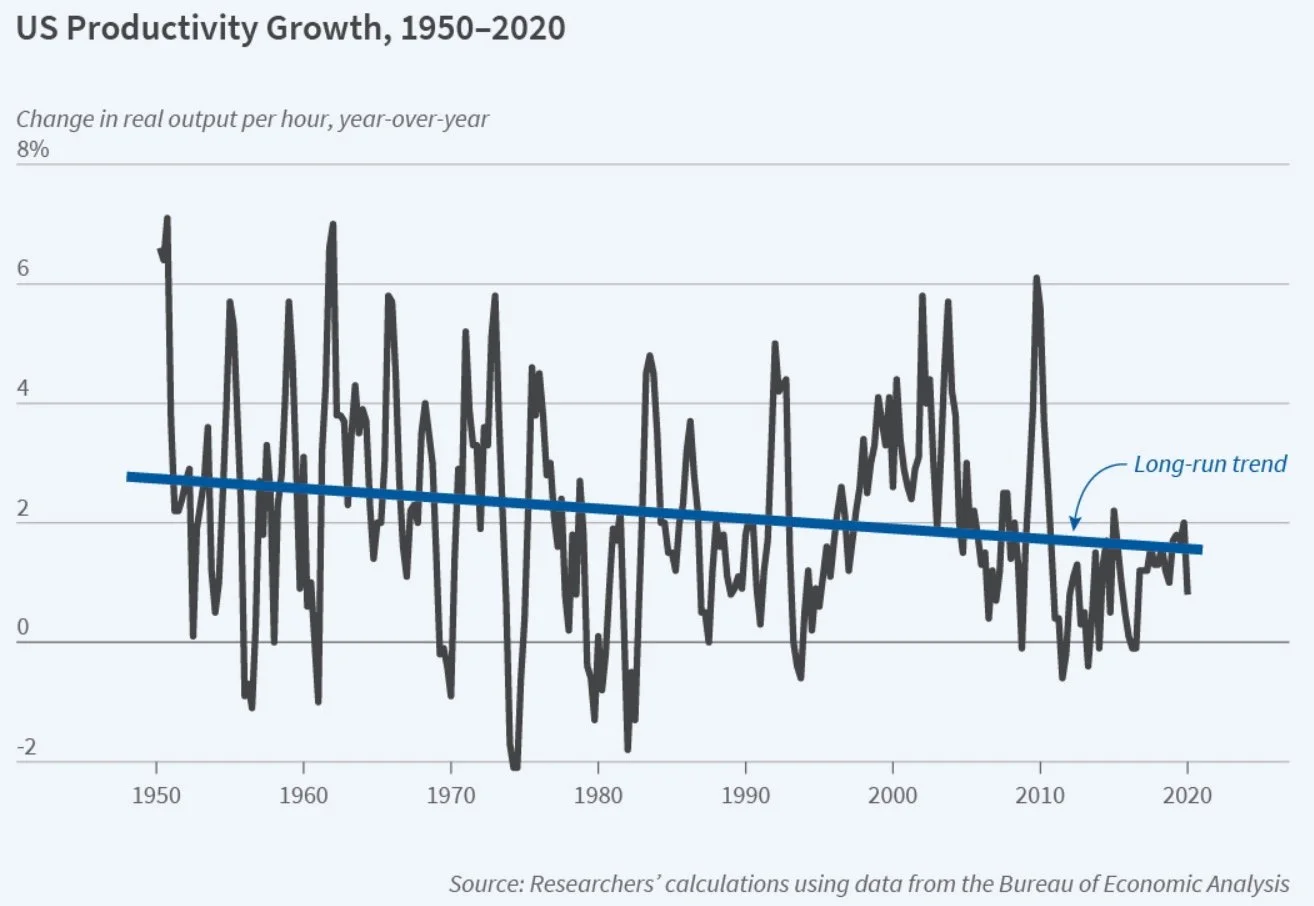
Recent years have seen growing concerns that US gross domestic product (GDP) growth is slowing. A factor that accounts for about half of this slowdown is the decline of labor productivity growth [Figure 1], which fell by roughly half, from 3 percent to 1.5 percent, between 1950 and 2019. The other half of slowing growth is due to declining growth of labor hours, due roughly equally to declining population growth and declining labor force participation.2 National productivity is defined as the amount of GDP that can be obtained with a given set of inputs. In this sense, productivity growth is “growth by inspiration” in that it yields more from less, in contrast to growth from increasing the use of inputs, which has been labeled “growth by perspiration.” As such, productivity growth is critical to driving long-run increases in the standard of living.
One immediate question is whether the productivity growth slowdown is real. An alternative view is that the observed slowdown in productivity growth could be an artifact of some measurement issue such as the increasing importance of online activity, much of which may not be recorded in conventional GDP statistics. Several recent studies argue against this view: they conclude that the decline in productivity growth is real, rather than due to measurement issues in inputs and outputs, transfer pricing, or cyclical issues related to the end of the 1990s information technology boom.3
This then leads to another question: what is driving the fall in productivity? Robert Gordon argues that a combination of headwinds accounts for this slowdown.4 One is the slowing growth of educational attainment, which began around 1980 with the annual growth rate of the percentage of the population completing high school falling from 3.3 percent per year until 1980 to only 0.2 percent after 1980, with similar slowdowns in college enrollment growth.
The second headwind Gordon highlights is the slowdown of productivity growth after the end of the Great Inventions Era. He argues that inventions such as sanitation, antibiotics, steam and electric power, radio, telephone, and air conditioning drove rapid national growth during the first part of the 20th century, and that comparably high-impact inventions have not been produced as frequently in recent years. Nicholas Bloom, Charles Jones, John Van Reenen, and Michael Webb build on this idea, arguing empirically that new ideas like these great inventions are becoming increasingly hard to find.5 They document that innovation output per R&D dollar or per scientist is falling, perhaps because the lower-hanging fruits on the knowledge tree are getting plucked over time.
A final, more positive headwind may be that the huge productivity benefits derived from modern information communication technologies (ICT) like computers, the internet, and smartphones take time to show up in national productivity. Erik Brynjolfsson, Daniel Rock, and Chad Syverson argue that since it took almost 50 years in the first half of the 20th century to incorporate electricity fully into modern factories and offices, we should be more patient in looking for the productivity impact of ICT.6 This is the ICT productivity J-curve — an initially slow productivity impact as society has to reorganize to use these new technologies efficiently, but a longer-run acceleration once they are effectively exploited.
Following this narrative, a reasonable outlook is that these modern great inventions will eventually raise productivity growth, overcoming some of the first two headwinds. But it may take another 10 or 20 years for society to reorganize itself to exploit them. Of course, one step toward that has potentially been the massive shift to working from home during the pandemic, for which ICT has been invaluable.7 Indeed, one could argue this almost certainly improved productivity versus any pre-computer version of working from home, so in that sense the enormous productivity impact of modern ICT has already begun.
Innovation
A second focus of academics and policymakers in recent years has been trying to understand the causes and consequences of rising inequality in the United States and other developed countries.8From an innovation policy perspective, several questions are of interest. Have innovation policies — such as government-awarded market power through patents and antitrust policy decisions — contributed to the observed rise in inequality? How does inequality at a societal level impact who becomes an inventor and what they invent? Tremendous progress is being made in developing new conceptual frameworks, datasets, and empirical approaches to tackle these questions at both the macro and micro levels.
At the macro level, two recent studies consider how innovation affects inequality in Schumpeterian growth models.9 One of these studies also leverages variation in the composition of the US Senate Committee on Appropriations to empirically test for a causal link between innovation and inequality, and argues that a 1 percent increase in patents increases the top 1 percent’s income share by 0.2 percent.10
At the micro level, research in fields such as health economics and labor economics has provided evidence on how innovation affects inequality. David Cutler, Ellen Meara, and Seth Richards-Shubik point out that when the most common causes of death vary across demographic groups, a policy of equalizing the expected marginal benefit of research across diseases can increase cross-group disparities in mortality outcomes.11 Taking this idea to the data, they suggest that National Institutes of Health-funded research increased the Black-White infant mortality gap between 1950 and 2007.
Two recent studies have explored the link between innovation and earnings inequality. Patrick Kline, Neviana Petkova, Heidi Williams, and Owen Zidar develop a novel firm-level linkage between patent applications and US Treasury firm/worker tax filings, and document that patent allowances raise average earnings at the firm level but also exacerbate within-firm inequality on a number of margins — with earnings of top-earning employees, firm officers, and male employees responding more strongly to patent grants.12 Related research using a novel firm-level linkage between patents and US Social Security Administration earnings records suggests that rising inequality in innovation activity across firms in the 1990s, as measured by patenting, can account for a significant share of the recent rise in income inequality.13

Of course, inequality at the societal level might also affect who becomes an inventor, and what they invent. Several recent studies have constructed linked data enabling new analyses of how demographic factors are associated with the probability of inventing, as measured by patenting.14Figure 2 documents that children from high-income (top 1 percent) families are 10 times as likely to become inventors as those from below-median-income families. While the results from these papers suggest that public policies could influence who becomes an inventor, it is difficult to derive quantitative conclusions from these descriptive analyses. An important step in closing this gap is provided by the work of Chang-Tai Hsieh, Erik Hurst, Chad Jones, and Peter Klenow, who estimate that between 20 and 40 percent of the increase in US output per person between 1960 and 2010 can be explained by an improved allocation of talent, notably the convergence in occupations across gender and race.15
Entrepreneurship
Given the concerns about stagnant productivity and rising inequality, it is natural to wonder whether either or both concerns are being — or have the potential to be — addressed by the burgeoning number of new high-potential ventures. Much attention in recent years has focused on the role of venture capital (VC) in fomenting innovation. The level of VC financing has rapidly increased over the last decade, in contrast with federal R&D which has been stagnant in the US. A number of economic models suggest that VC funds should be uniquely positioned to promote innovative growth in risky and uncertain environments, given their combination of careful screening, intense monitoring, and staged financing.16
The empirical literature, however, suggests a more nuanced picture. VC funding is increasingly concentrated in a relatively small number of startup firms that raise far more capital than in the past and stay private much longer.17 Much of the funding comes not from the venture investors themselves, but from investors who traditionally focused on public firms, such as mutual and hedge funds, as well as pension funds and other large institutional investors.
This concentration of capital may or may not be socially desirable; after all, the list of long-gestating firms that garnered extensive financing while private would include Alibaba, Facebook, and Uber, each of which undoubtedly has had profound economic impacts. But Josh Lerner and Ramana Nanda argue that while venture funding is very efficacious in stimulating a certain kind of innovative business, the scope is increasingly limited. For instance, using data on the patents filed at the US Patent and Trademark Office, they found that the top 10 patent classes using the US Cooperative Patent Classification (CPC) system represented 48 percent of all US VC patents filed over the 2008–17 period, compared to 24 percent for the top 10 patent classes for patents not filed by comparable VC-backed firms.18 This concentration has increased substantially over time.
This suggestion is underscored by computations by Sand Hill Econometrics. Susan Woodward and Robert Hall describe this firm’s indices, which suggest that an investment in all software deals between December 1991 and September 2019 would have yielded an annualized gross return of 24 percent, far greater than investments in hardware (17 percent), healthcare (13 percent), or clean tech (2 percent).19 These data further illustrate that the divergence in the performance of these categories has been particularly stark in the last decade. Thus, the shift of venture investment to software is not surprising.
A related concern is the increasing concentration of venture funds in the hands of a number of small groups. Not only are these funds concentrated geographically in a few urban areas, but the makeup of the most influential US firms is very different from that of the country as a whole. At VC firms and among the founders of VC-backed startups, women represent less than 10 percent of the entrepreneurial and VC labor pool, Hispanics about 2 percent, and African Americans less than 1 percent.20 This concentration appears despite the fact that women, Hispanics, and African Americans have much higher corresponding levels of representation in education programs that traditionally lead to careers in these sectors, as well as higher rates of representation in other highly compensated professions.
The disparities are also manifested in financing raised. For instance, using data from the Kauffman Firm Survey, Robert Fairlie, Alicia Robb, and David Robinson show that the typical White-owned firm had 35 times the amount of outside equity financing as the analogous Black-owned firm at the time of the initial survey, a difference that persists over time.21
These findings suggest that while VC is a powerful tool for boosting innovation, it is far from a panacea for addressing rising inequality or stagnant productivity across the economy.
Market Concentration Has Declined from the Consumer Perspective
THE DIGEST: No. 7, July 2021
Viewed from the consumer’s vantage point, 44.4 percent of all industries were highly concentrated in 1994, compared with 36.6 percent in 2019.

The extraordinary growth of companies like Alphabet, Amazon, and Apple, and high-profile mergers in fields such as airlines, hospitals, and media, have generated intense interest in the changing nature of competition in the United States. As megafirms have emerged in a number of industries, many studies have pointed to rising concentration as a possible explanation for the declining share of labor in national income, as well as low rates of corporate investment and productivity growth.
A study by C. Lanier Benkard, Ali Yurukoglu, and Anthony Lee Zhang suggests that determining whether concentration has been rising or falling depends critically on the boundaries one draws between different markets. From the producer’s perspective, data on business sectors collected by the Census Bureau show clear evidence that concentration has risen. In Concentration in Product Markets (NBER Working Paper 28745), the researchers instead focus on concentration in product markets as experienced by consumers — the approach that antitrust regulators adopt — and estimate that concentration trends have been falling, rather than rising, for the past 25 years.
To illustrate the different perspectives, the researchers consider the case of metal cans. The Census Bureau puts all metal can production into a single category, including soda cans, aerosol cans, and paint cans. But these products are not substitutes for one another and do not compete in product markets. Meanwhile, soda cans can be replaced by glass or plastic bottles, goods that have their own, separate, Census categories.
The Census Bureau also defines industries nationally, even though many products are not transportable and compete only locally. That can lead to skewed conclusions. For instance, at the national level, concentration in cable TV has risen dramatically over the last few decades. But at the local level, in the market that matters to consumers, competition has increased and more consumers have multiple cable and satellite suppliers to choose from.
From the perspective of consumers, the researchers show that concentration fell across the board in the past quarter century. Herfindahl-Hirschman indices (HHI) are a common measure of market concentration. The median HHI decreased from 2,265 to 1,945 between the years 1994 and 2019, and the HHI at the 90th percentile dropped from 5,325 to 4,570. Industries with HHIs between 1,500 and 2,500 are considered moderately concentrated, while those with HHIs above 2,500 are thought of as highly concentrated. In 1994, 44.4 percent of all industries were highly concentrated; in 2019, the comparable value was 36.6 percent.
Many manufacturing sectors have seen HHI decreases, while most nonmanufacturing sectors have seen no substantive change. Some industries were exceptions to the general trend. In the car rental industry, for example, HHI rose from 1,937 to 3,677.
Industries with the largest decreases in concentration often saw a new brand enter the market. In 1999, for example, Gorilla Glue started challenging dominant brands Elmer’s and Krazy, both of which are owned by the same company. By 2019, Gorilla had more than 30 percent of the market.
The researchers suggest that the dichotomy between increasing concentration at the sector level and decreasing concentration at the product level could be explained by declining costs of firms entering product markets that are adjacent to ones in which they already operate. In such a setting, efficient companies in a single-product market enter closely related product markets in which other firms are dominant. This process results in larger firms and higher concentration at the sector level and lower concentration at the product level. Overall production is more efficient, so if prices are determined primarily through product market competition, this process can benefit consumers.
— Laurent Belsie
The IT Revolution and Labor Market Activity of Older Workers
THE DIGEST: No. 7, July 2021
Limited skill with workplace computing raised the retirement rate for older workers by more than 1 percentage point a year when computers were introduced to jobs after 1984; these differentials began to disappear after 2000.

The revolution in the use of workplace computers that began in the 1980s took a toll on older workers who were not tech-savvy. They faced pay cuts, early retirement, and transfers to less intensive jobs.
In Computerization, Obsolescence, and the Length of Working Life (NBER Working Paper 28701), Péter Hudomiet and Robert J. Willis study how computerization affected older workers between 1984 and 2017. They find that the computer knowledge gap between older and younger US workers peaked in the 1980s and early 1990s, and then began to decline. It had disappeared by the mid-2010s.
The researchers use responses to a number of government surveys to calculate the probability that workers over age 50 were equipped with the computer skills called for in their occupations. Their measure of the knowledge gap captures the extent to which workers fall short of computer literacy. For example, if 70 percent of secretaries aged 40–49 in 1992 used word processors rather than typewriters, while 60 percent of secretaries over the age of 50 did so, the knowledge gap would be 10 percentage points.
The researchers estimate that computer knowledge gaps increased the likelihood that older workers — ages 50–69 — would retire by 1 to 1.4 percentage points per year. This raised the retirement rate for this age group from about 8 percent to over 9 percent per year. They also estimate that a 10-percentage-point knowledge gap reduced annual wages by at least 2.5 percent, and perhaps as much as 7 percent.
Four subgroups of the population were particularly hard hit by knowledge gaps: women, workers in office jobs, workers with some college education, and workers between the ages of 60 and 64. Women may have been more affected because they were less likely to learn to use computers than men. Office workers such as bookkeepers may have seen computers replace their jobs altogether. More highly educated workers may have had greater opportunity to find non-computer-intensive work. And for older workers in general, companies may have decided that it was not worth retraining those who were already near the end of their careers.
The impact of computers on a worker’s prospects was associated with his or her education. Among high school dropouts, the fraction of computer users at work remained low throughout the study period. Among high school graduates, computer use in the workplace became significant during the 1990s.
For some occupations, such as maintenance and food service, computer use remained negligible. Older workers in moderately skilled occupations, such as property management, sales, and factory floor supervision, lagged behind their younger peers in computer knowledge well into the current century.
— Steve Maas
The Rise of High-Skilled Workers as ‘Human Capitalists’
THE DIGEST: No. 7, July 2021
Labor’s share of corporate earnings has shrunk in recent decades, but when equity-based payments are included in compensation, the decline for high-skill workers is almost entirely eliminated.
Standard estimates of the recent decline in labor’s share of national income are likely to overstate the drop by failing to account for a large fraction of compensation in the form of equity grants and stock options. In Human Capitalists (NBER Working Paper 28815), Andrea L. Eisfeldt, Antonio Falato, and Mindy Z. Xiaolan report on a new class of high-skilled workers who, since the 1980s, have seen equity-based compensation increase to 40 percent of their earnings. The researchers estimate that equity compensation now constitutes 7 percent of corporate value-added, up from under 1 percent in 1980.

The researchers find that 78 percent of equity-based pay now goes to employees below the level of the executive suite and that human capitalists own a 10 percent stake in the public companies analyzed. Including equity-based compensation reduces by nearly a third the decline in wage-only income as a share of value-added since the 1980s, they calculate. For high-skilled labor, counting equity-based compensation almost eliminates the decline.
Even after equity-based compensation is factored in, labor’s share of corporate earnings has shrunk in recent decades. But the gap is far more evident among lower-skilled, wage-dependent workers. Augmented by stock options, capital gains, and dividends, the high-skill share of total labor income increased from 46 percent at the start of the 1980s to 58 percent today while the employment share of high-skilled workers remained flat at 30 percent.
The increased prevalence of equity-based compensation has been a win-win for high-skill employees and their employers. These workers benefit from lower tax rates on capital gains after exercising stock options, and firms use the prospect of stock grants as an incentive for retaining prized employees. Further, substituting equity pay for wages historically reduced reported labor costs and boosted annual earnings. The researchers estimate that 91 percent of equity pay has been used to replace wages rather than as compensation for increased productivity.
Standard data sources, such as the Bureau of Labor Statistics, do not capture the majority of equity pay, much of which is taxed as long-term capital gains, not as ordinary income. Additionally, since stock options are not exercised immediately, they often do not show up in income data for the year in which they were granted.
The researchers overcome the measurement hurdles by mining Securities and Exchange Commission filings on shares reserved for compensation reported by a broad range of firms in the manufacturing, health, consumer goods, and high-tech sectors from 1960 to 2019.
Their compensation calculations show that the greatest earnings gains go to human capitalists working in sectors that have experienced the largest declines in prices of investment goods. For example, as firms purchase cheaper and more powerful computers, they increase the productivity of high-skill workers. That complementary relationship between high-tech investment and high-skilled workers is not evident when wages alone are counted. By contrast, capital goods investment is negatively correlated with wage-based, low-skilled workers, reflecting the substitution of machines for people.
While total compensation at the C-suite level appears to have peaked around the year 2000, the researchers find, equity-based compensation to a broader set of high-skilled labor continues to rise.
— Steve Maas
Catering Industry Transformation Driven by Consumption Upgrade
Deloitte

China’s catering industry has been integrated during the 12th Five-Year Plan period while high-grade catering consumption has been pent up, dragging down the overall industry growth. With strong consumption upgrade in 2016, the first year of China’s 13th Five-Year Plan, public catering consumption has started to grow rapidly with more diversified service targets and demands. Technological advances have also reshaped the consumption via consumers’ decision-making processes and payments. Driven by complex and changing demands as well as advancements in technology, catering, one traditional service industry, has seen a new round of opportunities for transformation and upgrading. Stable consumption growth helps strengthen the long-term positive prospect of catering market and attract more capital and crossover competitors. Deloitte believes that China’s catering industry will reach to a new stage of diversified development and competition over the next few years. Key observations of this report are as follows:
Consumption upgrade leads a rapid recovery in catering. In the trend of consumption upgrade, public catering has become the pivotal force in boosting the industry growth, as consumers are more willing to dine out. Meanwhile, the rising next generation of consumers bring more diversified demands, creating scope for growth in different types of catering categories.
Chain catering enterprises drive the entire industry to scale up and develop effectively. In recent years, chain enterprises with efficient operation and rapid expansion are taking center stages. Based on the findings of studies on these enterprises, business format/ brand innovation, digital transformation, industry chain extension and capital market operation will be the major development directions. Such measures will facilitate the industry transformation and upgrade in terms of product, service, quality and efficiency. Although the concentration of China’s catering industry remains low with a lack of enterprises at ten-billion level, there is much development space for chain catering groups and the industry is expected to see further expansion and integration.
The rise and adoption of technology promote the digital transformation of catering industry. Technology adoption, represented by the Internet, provides new channels for catering enterprises to connect with consumers and strong support for enterprise management. And thereby digital transformation proves to be one key development direction for catering enterprises. The application of emerging technologies, including big data and Internet of Things, also helps drive up the operation and management of catering enterprises.
Catering industry is more active in capital market. Catering enterprises have gained increasing attention from capital market and started engaging more actively in the capital operation. The approved IPO application of Guangzhou Restaurant puts and end to the absence of catering enterprises listing in the A-share for years, expecting to open up a new door for A-sharing listing of catering enterprises. Smaller catering enterprises have listed in NEEQ to obtain attention and support from capital. PE/VC investment for catering enterprises has also increased constantly with a sizable percentage invested in enterprises in angel rounds, reflecting investors’ optimism for catering industry. 2
Policy guidelines shall not be overlooked: tax compliance and food safety have become the regulation focus in catering industry. As the impact of policy guidelines on the industry is a major systematic risk for its development, catering enterprises need to develop prior planning with full attention to compliance issues to be not affected. Recent policies indicate that food safety has become the regulation focus while supporting the healthy industry growth; and relevant laws and regulations have been improved, tightening restrictions on enterprises. Tax and other issues caused by VAT reform also require sustained attention. For successful listing, enterprises shall advert to compliance in various aspects in early stages and avoid being impacted by non-compliance on listing progress.
Automotive aftermarket set for fast growth, prompting digital transformation of auto accessories supply chain logistics
Deloitte
The development potential of automotive aftermarket is being unleashed as China's automotive market matures, according to China automotive aftermarket logistics service insights, a joint report issued by Deloitte and JD Logistics. Accordingly, auto accessories business is playing a greater role in the development strategies of automotive OEMs, and is set to become a key segment in future market competition. Meanwhile, the transformation of parts and accessories services will bring more new opportunities to the logistics industry.

According to the report, China's car ownership reached 217 million vehicles at the end of 2017, ranking first worldwide in sales for an eighth straight year. As forecasted, vehicles aged between four and nine years old will account for more than 50% of the vehicles in China in 2018, bringing demand for auto repairs and maintenance to a peak. The automotive aftermarket's scale is expected to exceed RMB1 trillion in 2018, representing an annual growth rate of more than 30%. The rise of China's automotive aftermarket will bring business opportunities to its underlying sectors, including accessories supply chain segment, which is a target market of JD Logistics.
Compared to the automotive OEM supply chain, accessories supply chain management is more complicated. The variety, "long tail effect" and complexity of goods are major difficulties auto parts and accessories logistics face. Given increasing demand for timeliness, and cost control considerations, digital capacity is crucial for logistics companies, requiring stock capacity for a large volume of SKUs and predictive capacity based on big data.
Globally, however, the number of auto manufacturers already able to leverage digital accessories management is limited. "Logistics and supply chain companies with digital capacity are becoming the hard core driving digital transformation in the industry," says Zhang Tianbing, leader of Deloitte China consumer products & retail sectors.
Meanwhile, as emerging technologies power changes in car buying and aftermarket service experience, auto manufacturers must proactively respond to trends and reconsider how to connect with internet consumers to cope with their rising expectations for product and service experience. The report suggests identifying service opportunities by profiling and analysing consumer attitudes, needs, behaviour, and customer characteristics before innovating logistics and supply chains is an effective route to transformation for the logistics industry.
As next generation consumers are more reliant on the internet, the way people commute is being disrupted. The development and popularization of car sharing and new energy vehicles will impact the automotive aftermarket. Car sharing could centralize aftermarket logistics service, making it more effective, and change the currently small, fragmented and disorganized end-user market of auto accessories logistics by gradually bringing in standards and regulations. For new energy vehicles, although this emerging sector has changed the competitive landscape of the current auto accessories logistics sector, transport, recycling and warehousing of automotive batteries are raising the bar for the logistics industry.
It is clear that healthy development of the automotive aftermarket will rely on continuous smart transformation of the auto accessories supply chain. In future, the auto accessories supply chain will have ample space for development. By building a complete supply chain, companies can manage inventory dynamically as well as improve upstream and downstream transport time in return for higher efficiency and cost advantages.
"As the new economy prospers, the potential of the auto accessories supply chain is tremendous. Existing pain points and potential challenges will become the main driver for companies to unleash their power," Zhang concludes.
Post-disaster Zhengzhou: When a City Suddenly Lost Internet
Du Qiang From Story hardcore
In Zhengzhou after the flood, a person with water, electricity and the Internet at the same time is extremely lucky.
Water outages are most widespread.In supermarkets, large bottles of drinking water have been snapped up, and the remaining small bottles have been carried away in bags.In the twenty-sevenSmall hotel near the tower, customers crowded around the front desk complaining, “It really stinks!” The boss pulled out the large plastic bucket from under his feet and pointed at the doorA deep pit of water, “Fill it up, punch it with that.”
The whole Zhengzhou City, a large area of power outages, old blocks because of aging electrical circuits can not be spared. A large number of shops along the street closed their doors, and fresh food businesses that did not close their doors sold fish and milk at a discount that could not be refrigerated. And dug out a long time did not use the spring scale, but the settlement link is often unable to complete - cash disappeared from life for too long, banks are still closed due to power outages, some even return to the original stage of "bartering."
In a fresh supermarket by the Qili River, the boss sat in front of the shop, A middle-aged man came out of a dark shop, carrying a bag of onions and small winter melon, weighing the total price of about 20 yuan.
“Cash only.”
"Can't use Alipay?" Asked the customer.
"Can you open Alipay?"
Middle-aged men don't have cash. After looking for a long time in the black leather bag, he could only hand the boss a pack of cigarettes - blue packaging, the market price of about 19 yuan. (This is reminiscent of the post-World War II economic collapse in Germany, where people used stored, easily divided cigarettes as "currency.")
Water and electricity outages exist in the memory of generations, but the sudden disruption of the Internet has turned Zhengzhou into an unprecedented testing ground. After the disaster in Zhengzhou, it is surprising that there are several meters of water in the tunnel of Longhai Road and cars floating in it. It is also in this city of 12,600,000 that the order given by Internet technology has failed, and the old order has failed.
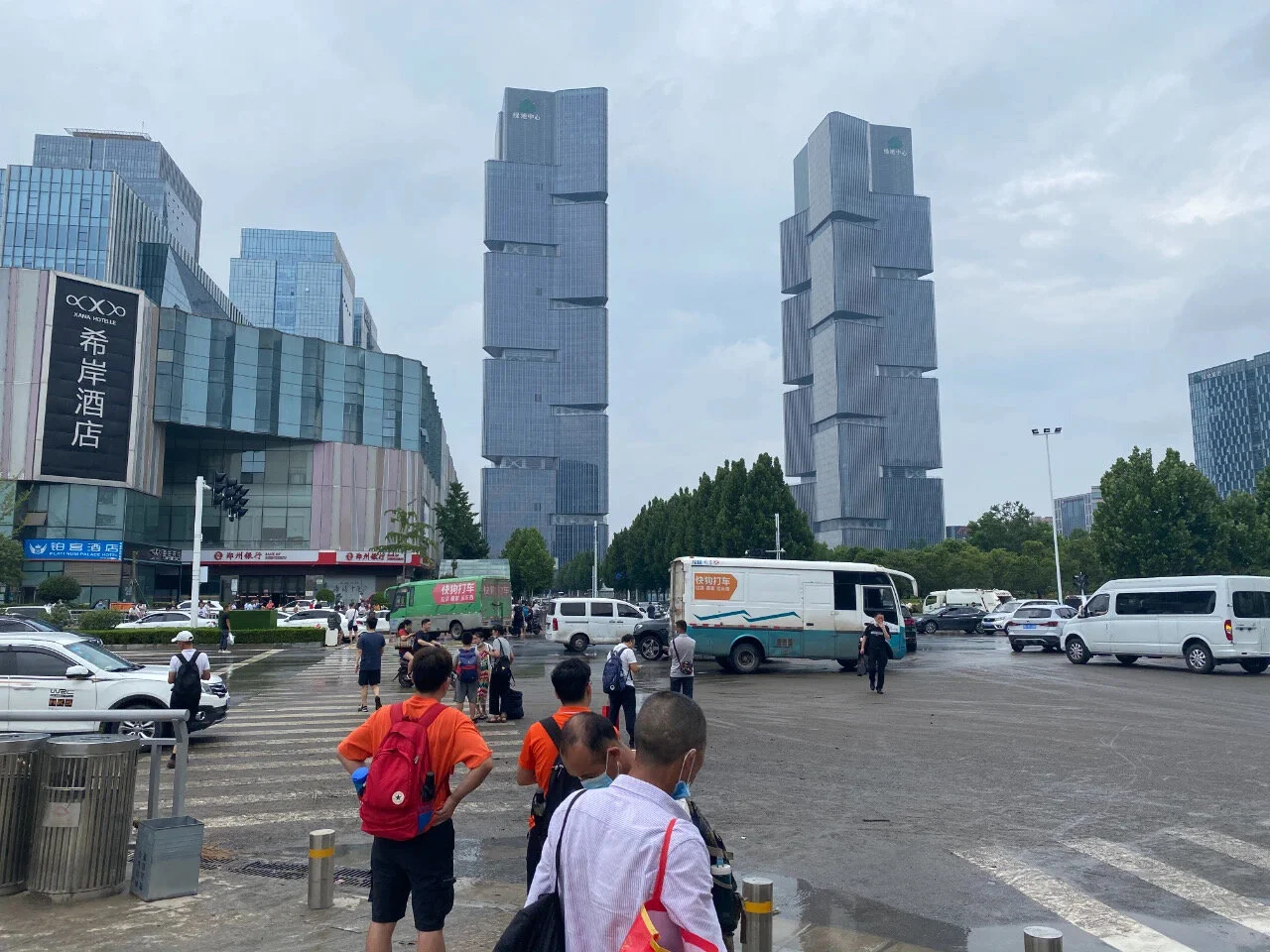
After July 20, Zhengzhou seemed to go back to the year 2000 overnight. Where can we find an oasis of digital civilization in a city where there is no electricity or internet? Citizens are deeply disturbed by it.
Zhengzhou East Railway Station is near the water, electricity, network without the three areas. The gates at the exit gate of the high-speed railway were all malfunctioned. Passengers who needed to brush their ID cards or tickets to exit the station simply squeezed out of the gate which could not be rotated. And when they walk out of the station square, they will find that the city's main public transport, has become a bike sharing and fast dog taxi, goods Lala.
For security reasons, several major ride-hailing platforms have suspended business within Zhengzhou. Most bus lines also stop running. So you'll see passengers pulling suitcases rashly stop Shunfeng Express's van and ask the driver loudly, "do you want to pull people?" And the intersection to the southwest of the station has become a trading place. when a taxi comes empty, passengers will immediately gather around it. "you can pay as much as you say and don't turn on the meter."
But drivers don't care about the price. They always ask, “Do you have any cash? WeChat Alipay can't brush.”
The first three groups of people who came forward to inquire left disappointed. Occasionally, passengers questioned the driver's "fortune," The driver did not deliberately make a grievance expression, "I this is a new energy vehicle, this point of electricity is finished, do not know where to charge, electricity piles are waste." According to a data from Zhengzhou, more than 80% of the city's taxis have been replaced by new energy vehicles.
At noon on the 21st, hundreds of passengers stranded at the intersection in front of the station, in the crowd, bags and water between the shuttle of private cars, fast dog taxi and goods Lala occupy the absolute main force. No matter whether it is Wuling Hongguang or Jinbei, passengers do not dislike, even sitting on strangers' lap is quite tolerant.
After I decided to go to the first affiliated hospital of Zheng University, I stopped a truck with a fast dog. The driver was a middle-aged man of about 40 with a short crew cut, who looked well established. But when asked about the price of a one-way trip, he suddenly became shy. "How much did you say?" After some pushback, I realized that he was new to this sudden new business. He pulled out his phone. "I'll see how far it is on the Gaudet map." But a minute later, he said, "No net."
After the development of Internet technology, city dwellers have become accustomed to the order it shapes, it defines the flow of transactions, Even the sense of trust between people is also built on the mechanism of Internet products, you will not worry about Taobao shop owner wrong money, nor for Didi driver detour and anxiety, lost mobile phone seven or eight out of ten can be found back. But on July 21st in Zhengzhou, I tried cautiously with the fast dog driver, as if trying to recover a skill that had been unfamiliar for many years.
This unprecedented situation is a test for the citizens of Zhengzhou. It seemed to me that they behaved very civilly. Beneath the malfunctioning traffic lights, the drivers were politely courteous, you might even say with a touch of shyness in their smiles. When a taxi stopped at the East Railway Station Square, the passenger got off and found that he did not have the cash, he repeatedly apologized, the driver just waved his hand, hit the steering wheel and headed east.
There are angry and angry situations, of course, but they can be forgiven depending on the plot. In Dongzhan South Road, a guy with a camouflage backpack tried to scan a Meituan bicycle. After many attempts to no avail, he was sweating heavily. He held up his phone and twirled it around in vain, like the African immigrant in Horsey's Gold Award photography "The Signal." A few minutes later he threw two punches at the QR code of Meituan Bicycle.

After the floodThe Streets of Zhengzhou
There are nearly 100 shared bikes scattered around South Dongzhan Road, Meituan, Green Orange and Hello were divided into three groups. In half an hour, more than 30 people tried to scan the code, but only two of them caught the weak signal. A student like young man successfully scan the code, humming the Divine Comedy, "riding my beloved bicycle..." More people are left to look around for an Internet product more suited to the moment of failure - a shared bike with a broken lock.
In such extreme cases, newer may not necessarily mean better. Meituan Bicycle has launched a new generation of bicycles in Zhengzhou, giving up the traditional lock. The new lock probably applies the principle of electromagnetism. When returning the car, it still needs to scan the code and determine whether it is located in the designated parking space by the system. However, the extra network communication makes the people of Zhengzhou very annoyed at the moment.
On the other hand, some seemingly primitive technology may come in handy. An emergency guide circulated among media groups ahead of the flood suggested a technology that could send content directly to 1069009009 without a 4G signal for help on Weibo. The microblogging system has left a lifeline through the 2G network.
Just like Zhengzhou,The original city is not prepared for more than 500 millimeters of precipitation a day, Most Internet technology companies add more and more sophisticated designs to the foundation of network communications, but who knows what happens when that foundation is gone without one.

The passenger is inquiring about the taxi
The Internet is the new infrastructure, the hydroelectric coal of our age. There is nothing false about that. This is especially unlikely when you continue to walk west along South East Railway Station Street and see bewildered crowds holding mobile phones.
Shops along the route are mostly closed, especially large chains such as McDonald's, and small stores are still open.
"Hello, I booked on Ctrip." I said to the receptionist at a small hotel called Yi Lai.
"Ctrip?" She pointed to the computer in front of her. "I have no power now. Where can I see where you booked me?" Under her hand was a paper form, each room number drawn with thick lines. A steady stream of customers came in, many went to the front desk,Take a look.Eye yellow, green all kinds of shared charge treasure, and turned away.
3 km west, power restored after passing the Green Center. At a lamb soup restaurant, the boss told me that I can't order a takeaway now. “We didn't stop Meituan. We turned it off manually. It's just a list. 40 minutes without a rider, then the guest will return, the meal has already been done, we still have to bear the loss. Just turn it off.”
Without the Internet, life has to be readjusted everywhere. However, people who are not in it seem to have been unable to understand the feeling of not having a network.
On the evening of the 21st, Meituan sent a text message, “To ensure the convenience of public access in extreme weather, Meituan Bike will ride for free in Zhengzhou from 21st to 28th, the fee you paid has been refunded to the original account. Special reminder, before riding make sure the road and vision is good, standing water section, do not wade through water. Weather share, Zhengzhou refueling!”
After I received the message, I wanted to give my good friends a hug and thank them for their thoughtfulness, but also to whisper in his ear, stupid, the problem is not money at all.
In the evening, Zhengzhou began to rain heavily again. After 8: 30, wearing a raincoat, I rushed from the Provincial People's Hospital to my hotel near Zhengxing Street. The street lights and traffic lights along Renmin Road were all extinguished. The vision and road conditions were very bad. During the 40-minute walk, more than a dozen shared bikes were encountered along the way, but there was still no Internet, so we could not scan the code.
I turned on the lights on my phone and stared at a GoDaddy map downloaded offline as I walked. After the flood, Gold Online Storm Help function, in the emergency location, will show a red mark on the map. But if you are not in the oasis of the Internet, you have no idea to open it. Friends in Beijing can use it, but they don't need it.
According to the map information, I walked to the Erqi Tower nearby, after turning a fence, was stopped by a figure.
"Brother don't go, there is a big puddle in front, you can't pass." He looked older than me, but it was so dark then.
"Walk around that side, can pass, you watch the puddle, don't step on." He continued.
I thanked him and asked if he was a government worker.
“No. I live nearby and I knew there was a big pit. I thought no, I stood here for a while.” He saw the map in my phone. "Don't just look at that. It doesn't work now."
There is no doubt that until power and Internet are restored, the slow restoration of order in the city of Zhengzhou depends on ordinary people, the truckers, the street cleaners, The dedicated traffic police, as well as the hotel downstairs for passers-by to open a free Internet hotspot waitress, is the Internet technology developed before we have empathy, responsibility, and even for self-interest purposes. Not to be nostalgic or defensive about these "primitive" things, but to be honest, because of the advanced technology, the fine governance, sometimes I have almost forgotten them.

In the afternoon of the 21st, in a small square near Dongnan Road, I met Zhang, a resident nearby. He had not been out for two days and was sitting on the steps looking out. He told me about the difficulty of water and power outages nearby, talking about the floating cars in the culvert not far away, but finally concluded, "Henan people are afraid of what, disasters see much."
For two days, Big Brother Zhang did not dare to use his mobile phone, “There is only (percent) more electricity left. But it also saves electricity, no internet.”
"So what do you think about the news and the government circulars?" I asked.
“I was told by others (neighbors) that there was another flood discharge. We're all very close.”
Since the floods, most of the city government's information has been transmitted through the Internet. Television stations have also had related news, but it is the same old problem. There is no electricity and no Internet. It is probably impossible to estimate how many people are thus isolated from important information.
Now Zhang Eldest Brother is worried, worried about mobile phone battery can not contact home, intend to drive back, and worry about the road is not safe.
He was originally from Xuchang and worked hard in Zhengzhou for many years. The youngest daughter is now 3 and has only been back to her hometown twice. "I always want to go back, let the old see the children, my wife is afraid of going back to the trouble, always said WeChat video to see on the line, the same."
"How can that be the same?" "It's definitely different," he said.
Looking at the global "flying car", is human flight far away?
Electronic Engineering Album

EVTOL, manned drones, flying cars, this is the same product of the future. It will address ground traffic and provide a second airspace for low-altitude traffic flights. It will also be a transitional phase for humans into space. Are flying cars reliable? What is the status and when will it become widespread?
More recently, Tesla has been blasted or moved into the flying car market, once again pushing manned drones to the forefront of technology.
allBall Flying Cars Inventory
We don't know much about flying car companies and products. However, more than 200 companies worldwide have been developing and testing vehicles, the longest for more than a decade. This section mainly takes stock of flying cars and companies that have been tested, products, designs, or more famous. The following rankings are in no particular order and do not represent market position or technological leadership.
Tesla may enter board, flying cars may start popular
According to reports, investment bank Morgan Stanley recently released an investment research report, the target price of Tesla shares at 900 dollars, continue to maintain its stock "overweight" rating. Morgan Stanley analyst Adam Jonas. Jonas said in the report that he did not believe Tesla would not enter the "electric vertical take-off and landing vehicle" (eVTOL) market.
Tesla CEO Elon Musk did not really talk about eVTOL, Jonas said. And, when asked about eVTOL, he dismissed the "flying car."
But, given that Tesla is aggressively "industrializing" electric cars, self-driving cars, battery storage, connected car networks and electric vehicle infrastructure, he's not convinced Tesla has no interest in eVTOL, the technologies are just too close.
Jonas even thinks it's no longer a matter of "if" Tesla will enter the eVTOL market, but "when."
The above picture is a rendering of the Tesla flying car, from the point of view of industrial design, is indeed "Tesla": cutting-edge technology, industrial design first-class. And true aerodynamics. However, it is not clear where people will be "loaded."

Volocopter, Germany, urban air traffic trailblazer
Micron Technology, Inc. (NASDAQ: MU), its strategic investment entity, Microns Ventures, announced on October 24, 2019. (NYSE: VW) Ventures is participating in a Series C investment in urban air traffic trailblazer Volocopter. Volocopter Is a manufacturer of electric vertical take-off and landing aircraft that meet today's safety standards for air transport and exceed those for helicopters. Volocopter is seeking to commercialise an autonomous and on-demand air taxi service.

Extended air traffic
As a growing population moves to cities, existing traffic patterns face limits. The need to find a solution inspires Volocopter Such as the explosive innovation and disruptive growth of private enterprises. The Germany-based start-up has been experiential testing its air taxi technology for almost a decade, with its electric vertical take-off and landing (eVTOL) Airplanes not only meet the need to constantly reinvent the transportation systems of megacities, but also provide people with new ways to commute.
“Volocopter Is a wonderful company dealing with a favorable position in driving change in the transportation and transportation market and contributing to building sustainable and environmentally friendly transportation infrastructure, ” René, Vice President, Corporate Business Development, Micron Technologies Hartner said. “Micron in Volocopter Uber's investment is consistent with our view that memory and storage solutions play a key role in enabling the breakthrough capabilities required for autonomous vehicles and edge computing. ”
Micron is the largest supplier of memory to the automotive industry and its high-performance solutions facilitate the development of autonomous driving, virtual reality and air travel. MicronVenture vs. Volocopter Micron's investment reflects its continuous search for new and innovative solutions.
"We are proud to partner with Micron to realize our bold vision of making urban air traffic a reality," Volocopter CEO Florian Reuter Said.“Volocopter Will help major cities transform their transport infrastructure and thus move towards a more sustainable future. Our goal is to provide affordable, automated, on-demand air taxi services to pick up and drop off passengers in megacities - all for the cost of a taxi ride and significant time savings. ”
In addition to air taxis, Volocopter is developing an ecosystem for urban air traffic while working with the European Union's Aviation Safety Agency to seek Class I certification for use in commercial transport. This work includes building connectivity VoloCity aircraft with major downtown transportation hubs such as airports and business districts for VoloPorts.
In addition, Volocopter has the VoloConnect Long Way concept aircraft and logistics drones:

Volocopter is doing well in Singapore, Southeast Asia and Europe.
In July 2017, Volocopter collaborated with the Dubai government to explore smart city air traffic;
Volocopter makes its first flight in the European city of Stuttgart on October 8, 2019;
Volocopter, Urban Air Traffic (UAM), December 9, 2020 Announced a commitment to work closely with Singapore / Bruhsar City to launch air taxi services in Singapore after two years. Volocopter works with the Economic Development Board of Singapore (EDB) and the Civil Aviation Authority (CAAS) Air taxi services in the Southeast Asian city-state are planned for the next three years;
On June 21, 2021, Volocopter 2X made its first flight at the French Air Show and is expected to become one of the Paris air taxis in 2024.
June 24, 2021 The European Union's aviation safety agency issued its first certificate in a new program under which drone manufacturers or operators can ask the agency to verify the design of drones used for specific purposes. The first such certificate was granted Volocopter VC200-2;
Japan Airlines partners with Volocopter to launch flying car service in 2025
In January 2021, a French company, FLY-R, designed a prototype of a new "biplane" drone. It features a unique diamond wing design that claims to be able to bring some distinct advantages.
In the latest display of the R2-150 The prototype is formed by a pair of front wings disposed at a low point, and a couple of rear wings disposed high, The front wings sweep back and the rear wings sweep forward and tilt down, so they join the front wing at the tip. It's almost a biplane, except the ends of the upper and lower wings are pinched together.
FLY-R The company, based in the Indian Ocean on the French island of Reunion, says the diamond design is superior to conventional wings in many ways. First, the wingspan has been cut by about half, and aerodynamic drag has been reduced. In addition, the structural mass has been reduced by about a third, and the aircraft remains stable over a wide range of speeds and is highly maneuverable.
Currently battery-powered R2-150 Is designed for completely autonomous missions such as surveillance, observation and reconnaissance. It has a wingspan of 1.5 meters (4.9 feet), a cruising speed of 115 kilometers per hour (71 miles per hour) and can fly for two hours per charge -- transmitting live video as it flies.
Other models are designed to go farther, carry heavier payloads and fly faster. For example, the jet-powered R2-HSTD plans a top speed of Mach 0.65 (803 km / h or 499 mph). It is intended as a target drone, for use in military exercises.
FLY-R even has plans for a short- and medium-range passenger aircraft, named the Crystal CR-1200. FLY-R Crystal The CR-1200 should be able to carry items weighing up to 800 kilograms (1,764 pounds). The aircraft can accommodate two pilots and eight passengers (although other configurations may be available), It will feature a hybrid system in which a fuel-burning generator will recharge an onboard battery pack, which in turn will power an electric motor for two push-back propellers. At its cruising speed of 350 km / h (217 mph), It can travel more than 1,000 kilometers (621 miles) without refueling -- a figure that would increase if it was not carrying the maximum possible payload.

Read More
Grid Core $100m Expands New York Plant, CEO Quashes Intel Takeover Rumors, Says IPO Will Go Ahead
U.S. semiconductor maker Global Foundries will build a second plant near its headquarters in Malta, New York, and invest $10 million to boost capacity to ease a global chip shortage, the company said Monday. Also participating in the day were U.S. Secretary of Commerce Gina Raimondo (Gina Sen. Chuck Schumer (D-N.Y.) and Sen. Raimondo (R-Mo.).
Meanwhile, in response to the recent "Wall Street Journal" reported that Intel (Intel) is ready to buy Grid Core for $30 billion, Gridcore CEO Tom Caulfield also denied on the spot and will continue to seek an IPO listing.
During the IPO, you'll see all kinds of rumors
Thomas Caulfield said the Intel deal was speculation and denied there had been such discussions. “We did not open any discussions on this. You're likely to see a lot of speculation as the company moves ahead with its IPO plans.”
From the grid core aspect of the response, they deny Intel's $30 billion acquisition news, whether it is really unaware or can not admit. However, it has also been reported that Intel's acquisition is likely to cross the grid core company and the parent company - the United Arab Emirates Mubadala Investment Fund (UAE) to talk, The latter burned tens of billions of dollars on grid cores.
But the focus of Mubadala is still to push Grid Core to go public according to established plans, people familiar with the matter said.
Intel 300000000000 US dollars to acquire Grid Core has a great impact, not only will reshape the global wafer foundry market pattern, For AMD is also at stake, grid core is still their important long-term OEM partner, if bought by Intel, the relationship will be somewhat troubled.
NH Investment & Securities analysts said the grid core could still be attractive to Intel despite its lack of up-to-date production processes, Business Korea reported. In the long-term development of the company, Grid Core accumulated a wide range of customers, IP and technology patents, which created a high asset value for its. For potential deals, these factors are as important as production processes, the agency argues.
Also, given that Intel's corporate culture and customer relationships revolve around its dominance of the PC and server CPU markets, it would be difficult for the company to re-enter the foundry space if it relied solely on process technology. The combination of Grid Core's assets and Intel's production processes will provide the necessary synergies for the foundry market.
The agency noted, however, that if the deal is finalized, competition in the foundry industry will become more intense, affecting incumbents such as Samsung and TSMC.

As for the expansion news, the grid cores are still in place a day early Official Account message template On sold a customs son, let a person think will announce and Intel, we did not expect to wait for the announcement of a new grid core brand and expansion of the news...
Grid Core said in its official news release that it will invest $10 million to immediately add 150,000 wafers a year to its existing Fab 8 fab to help solve the global chip shortage. Grid Core just moved its headquarters from California to New York earlier this year.
Later, Grid Core plans to build a new fab that will create more than 1,000 direct high-tech jobs and thousands of indirect jobs in the region, including high-paying construction jobs. According to Fab 8's successful investment model, Grid Core plans to fund new facilities through a public-private partnership that includes customer, federal and state investments. This additional capacity will meet growing demand for secure, feature-rich chips in high-growth markets including cars, 5G connectivity and the Internet of Things.
"There has been a chip shortage for 15 years." Thomas Caulfield said at the launch. These investments aimed at expanding Grid Core's U.S. manufacturing footprint are part of the company's broader global expansion plans, These include the recently announced new plant in Singapore and the planned $10 billion expansion of capacity in Germany, all to meet growing demand from customers worldwide.
Grid Core employs more than 15,000 people worldwide, 7,000 in the United States and nearly 3,000 at its headquarters in Malta, New York. Over the past decade, Grid Core has invested more than $15 billion in its Fab 8 plant to support innovation and increase production capacity.
Apple’s Vertical Integration

When Apple was preparing a metal case for the MacBook, Apple's chief designer Jony Ive thinks there is a huge problem with metal: It doesn't transmit light. That means adding a light to the MacBook, such as a laptop breathing light, would require more holes in the metal, but Ive thinks too many holes would be unsightly.
According to legend, Ive put together a team to work specifically on this problem. They discovered that tiny holes drilled by lasers into aluminum metal could allow light to come through -- and no one could see the holes. Apple didn't have the ability to do this on its own at the time, but market research revealed that a company in the United States had lasers capable of punching holes 20 μm in diameter at a cost of $250,000. So Apple bought the company.
Just to let aluminum metal can be transparent and take into account the beauty of this one thing, there is such a big move. Although the technology is no longer rare, the legacy of that acquisition can still be seen on devices like Apple's TrackPad.
Apple doesn't do this kind of thing once or twice: chip, display (LTPO, microLED), sensor (Face ID / Touch ID), brake (Taptic) (Engine) and other technologies, is a word against the acquisition. Like just for Face on the iPhone X ID, Apple for this acquisition of related enterprises at least include 3D sensing technology enterprise PrimeSense, camera module manufacturer LinX, AR company Vrvana, image sensor supplier InVisage Tech, AR eyewear manufacturer Akonia Holographics and others.
Apple now makes (or co-manufactures) its own chips and components, unlike its upstream suppliers, in that they are not for sale, but for its own consumer end products. One of the big differences between Apple's thinking and that of regular consumer electronics manufacturers is that there are functional / performance requirements first and then trying to figure out a solution - if you can't find one, try to build it yourself or help upstream manufacturers build it together. This line of thinking seems to have been handed down from Apple's earliest days.
EE Times USA has written an article in 2018 entitled Apple Goes Vertical & Why It The Matters article describes how Apple can acquire, invest, build its own team, and cooperate hard and soft to achieve a particular feature. Like Face. ID, not only to acquire a bunch of related image sensors, optical technology enterprises, but also to add the Neural Engine module in the chip, and to cooperate with the previous Secure Enclave, and support is most rapid at the system and software level.
Google predates Android Era 4.0 (2012) has done face recognition features in the operating system level, but both from the optical and sensor recognition level, Or chip TEE environment, system implementation, are far from the user experience ready - Google as an operating system supplier, does not have Apple's vertical integration capabilities, natural experience and security discount. This is a typical example. What's more scary is that Apple usually builds a technology that is mature and then can fire up the technology and even the chain, structured light and 3D. ToF has this component (although it often fails, such as 3D touch).
Open RAN
As 5G is being deployed all over the globe, one of the new trends drawing a lot of attention is the Open RAN, which has been selected by a number of major operators for their 5G deployments.
Open RAN is made possible through standardized open network interfaces, defined in 3GPP, O-RAN Alliance, IEEE, and other SDOs and industry fora. To cater to all the diverse 5G use cases and operator’s deployment constraints, the standards define multiple NG-RAN architecture options and the associated open network interfaces. While these options are crucial in making 5G suitable to address all the requirements and challenges of the next generation mobile network, figuring out which option fits a particular practical use case is sometimes challenging. This is further exacerbated by the fact that relevant standards are scattered across multiple SDOs.
To help experts to unpack that complexity, Sasha Sirotkin, the 3GPP RAN3 Vice-chair has edited a new book ‘5G Radio Access Network Architecture: The Dark Side of 5G’, with material contributed by a number of domain experts, active in various 3GPP working groups.
The following material is provided by Sasha and the publisher Wiley-IEEE, as a short introduction to the topic.
Monolithic vs. split architectures
When discussing the 5G RAN architectures, we often talk about functional splits – as opposed to the “monolithic” architecture in which a gNB is defined, and often implemented, as a single network node. The assumption that split architectures are unique to 5G is not entirely correct. Even though 3GPP defined the 4G eNB as a single monolithic logical network node, in practice deployments with Remote Radio Heads (connected via CPRI) were rather popular. And of course, there was the FAPI specification from the Small Cell Forum for LTE, not to mention various proprietary split implementations.
What’s new in 5G

With the advent of 5G, the industry realized the need for better standardization of RAN in general, and functional splits in particular. During the 5G study in Release-14, 3GPP have considered multiple split variants, illustrated by the figure below.
After extensive discussions, 3GPP have reached the consensus to define two NG-RAN split architectures (in addition to the traditional “monolithic” one):
the high-level CU/DU split (option 2),
and NG-RAN architecture with separated control and user plane functions.
Naturally, Small Cell Forum also evolved their FAPI specification (option 6) to support 5G, while O-RAN Alliances defined the low-level split (option 7). Furthermore, CPRI specification was enhanced (and is now referred as eCPRI) to support not only option 8, but also higher splits. This joint effort across multiple SDOs is a testament to the importance of Open RAN to the whole industry, which is now enabled through the definition of open standardized network interfaces between the split NG-RAN network nodes.
Artificial Intelligence and Machine Learning
By Gino Masini, Yin Gao, Sasha Sirotkin
5G brings more stringent requirements for Key Performance Indicators (KPIs) like latency, reliability, user experience, and others; jointly optimizing those KPIs is becoming more challenging due to the increased complexity of foreseen deployments. Operators and vendors are now turning their attention to Artificial Intelligence and Machine Learning (AI/ML) to address this challenge. For this reason, following RAN plenary approval, 3GPP RAN3 has recently started a new Release-17 study on the applications of AI/ML to RAN.

AI can be broadly defined as getting computers to perform tasks regarded as uniquely human. ML is one category of AI techniques: a large and somewhat loosely defined area of computer algorithms able to automatically improve their performance without explicit programming. AI algorithms were first conceived circa 1950, but only in recent years ML has become very popular partly due to massive advancements in computational power and to the possibility to store vast amounts of data. ML techniques have made tremendous progress in fields such as computer vision, natural language processing, and others.
ML algorithms can be divided into the following types:
-Supervised learning: given a training labeled data and desired output, the algorithms produce a function which can be used to predict the output. In other words, supervised learning algorithms infer a generalized rule that maps inputs to outputs. Most Deep Learning approaches are also based on supervised learning.
-Unsupervised learning: given some training data without pre-existing labels, the algorithms can search for patterns to uncover useful information.
-Reinforcement learning (RL): unlike the other types, which include a training phase (typically performed offline) and an inference phase (typically performed in “real time”), this approach is based on “real-time” interaction between an agent and the environment. The agent performs a certain action changing the state of the system, which leads to a “reward” or a “penalty”.
Perhaps the most obvious candidate for AI/ML in RAN is Self-Organizing Networks (SON) functionality, currently part of LTE and NR specifications (it was initially introduced in Rel-8 for LTE). With SON, the network self-adjusts and fine-tunes a range of parameters according to the different radio and traffic conditions, alleviating the burden of manual optimization for the operator. While the algorithms behind SON functions are not standardized in 3GPP, SON implementations are typically rule-based. One of the main differences between SON and an AI-based approach is the switch from a reactive paradigm to a proactive one.
The study has just begun, and at the time of writing we can only provide initial considerations. According to the mandate received from RAN, our study focuses on the functionality and the corresponding types of inputs and outputs (massive data collected from RAN, core network, and terminals), and on potential impacts on existing nodes and interfaces; the detailed AI/ML algorithms are out of RAN3 scope. Within the RAN architecture defined in RAN3, this study prioritizes NG-RAN, including EN-DC. In terms of use cases, the group has agreed to start with energy saving, load balancing, and mobility optimization. Although the importance of avoiding a duplication of SON was recognized, additional use cases may be discussed as the study progresses, according to companies’ contributions. The aim is to define a framework for AI/ML within the current NG-RAN architecture, and the AI/ML workflow being discussed should not prevent “thinking beyond”, if a use case requires so.
Stay tuned for further updates as the study progresses in RAN3, or consider joining us in our journey into the “uncharted” territory of AI/ML in NG-RAN.
Electricity load forecasting: a systematic review
Isaac Kofi Nti, Moses Teimeh, […]Adebayo Felix Adekoya
Journal of Electrical Systems and Information Technology
Abstract
The economic growth of every nation is highly related to its electricity infrastructure, network, and availability since electricity has become the central part of everyday life in this modern world. Hence, the global demand for electricity for residential and commercial purposes has seen an incredible increase. On the other side, electricity prices keep fluctuating over the past years and not mentioning the inadequacy in electricity generation to meet global demand. As a solution to this, numerous studies aimed at estimating future electrical energy demand for residential and commercial purposes to enable electricity generators, distributors, and suppliers to plan effectively ahead and promote energy conservation among the users. Notwithstanding, load forecasting is one of the major problems facing the power industry since the inception of electric power. The current study tried to undertake a systematic and critical review of about seventy-seven (77) relevant previous works reported in academic journals over nine years (2010–2020) in electricity demand forecasting. Specifically, attention was given to the following themes: (i) The forecasting algorithms used and their fitting ability in this field, (ii) the theories and factors affecting electricity consumption and the origin of research work, (iii) the relevant accuracy and error metrics applied in electricity load forecasting, and (iv) the forecasting period. The results revealed that 90% out of the top nine models used in electricity forecasting was artificial intelligence based, with artificial neural network (ANN) representing 28%. In this scope, ANN models were primarily used for short-term electricity forecasting where electrical energy consumption patterns are complicated. Concerning the accuracy metrics used, it was observed that root-mean-square error (RMSE) (38%) was the most used error metric among electricity forecasters, followed by mean absolute percentage error MAPE (35%). The study further revealed that 50% of electricity demand forecasting was based on weather and economic parameters, 8.33% on household lifestyle, 38.33% on historical energy consumption, and 3.33% on stock indices. Finally, we recap the challenges and opportunities for further research in electricity load forecasting locally and globally.
Background
Electricity is the pivot in upholding highly technologically advanced industrialisation in every economy [1,2,3]. Almost every activity done in this modern era hinges on electricity. The demand and usage of electric energy increase globally as the years past [4]; however, the process of generating, transmitting, and distributing electrical energy remains complicated and costly. Hence, effective grid management is an essential role in reducing the cost of energy production and increased in generating the capacity to meet the growing demand in electric energy [5].
Accordingly, effective grid management involves proper load demand planning, adequate maintenance schedule for generating, transmission and distribution lines, and efficient load distribution through the supply lines. Therefore, an accurate load forecasting will go a long way to maximise the efficiency of the planning process in the power generation industries [5, 6]. As a means to improve the accuracy of Electrical Energy Demand (EED) forecasting, several computational and statistical techniques have been applied to enhance forecast models [7].
EED forecasting techniques can be clustered into three (3), namely correlation, extrapolation, and a combination of both. The Extrapolation techniques (Trend analysis) involve fitting trend curves to primary historical data of electrical energy demand in a way to mirror the growth trend itself [7, 8]. Here, the future value of electricity demand is obtained from estimating the trend curve function at the preferred future point. Despite its simplicity, its results are very realistic in some instances [8].
On the other hand, correlation techniques (End-use and Economic models) involve relating the system load to several economic and demographic factors [7, 8]. Thus, the techniques ensure that the analysts capture the association existing between load increase patterns and other measurable factors. However, the disadvantage lies in the forecasting of economic and demographic factors, which is more complicated than the load forecast itself [7, 8]. Usually, economic and demographic factors such as population, building permits, heating, employment, ventilation, air conditioning system information, weather data, building structure, and business are used in correlation techniques [7,8,9]. Nevertheless, some researchers group EED forecasting models into two, viz. data-driven (artificial intelligence) methods (same as the extrapolation techniques) and engineering methods (same as correlation the techniques) [9]. All the same, no single method is accepted scientifically superior in all situations.
Also, proper planning and useful applications of electric load forecasting require particular “forecasting intervals,” also referred to as “lead time”. Based on the lead time, load forecasting can be grouped into four (4), namely: very short-term load forecasting (VSTLF), short-term load forecasting (STLF), medium-term load forecasting (MTLF) and long-term load forecasting (LTLF) [6, 7, 10]. The VSTLF is applicable in real-time control, and its predicting period is within minutes to 1 h ahead. The STLF is for making forecasting within 1 h to 7 days or month ahead [11]. It is usually used for the day-to-day operations of the utility industry, such as scheduling the generation and transmission of electric energy. The MTLF is used for forecasting of fuel purchase, maintenance, utility assessments. Its forecasting period ranges from 1 week to 1 year. While the LTLF is for making forecasting beyond a year to 20 years ahead, it is suitable for forecasting the construction of new generations, strategic planning, and changes in the electric energy supply and delivery system [10].
Notwithstanding the above-mentioned techniques and approaches available, EED forecasting is seen to be complicated and cannot easily be solved with simple mathematical formulas [2]. Also, Hong and Fan [12] pointed out that electric load forecasting has been a primary problem for the electric power industries, since the inception of the electric power. Regardless of the difficulty in electric load forecasting, the optimal and proficient economic set-up of electric power systems has continually occupied a vital position in the electric power industries [13]. This exercise permits the utility industries to examine the dynamic growth in load demand patterns to facilitate continuity planning for a better and accurate power system expansion. Consequently, inaccurate prediction leads to power shortage, which can lead to “dumsor” and unneeded development in the power system leading to unwanted expenditure [7, 14]. Besides, a robust EED forecasting is essential in developing countries having a low rate of electrification to facilitate a way for supporting the active development of the power systems [15].
Based on the sensitive nature of electricity demand forecasting in the power industries, there is a need for researchers and professionals to identify the challenges and opportunities in this area. Besides, as argued by Moher et al. [16], systematic reviews are the established reference for generating evidence in any research field for further studies. Our partial search of literature resulted in the following [10, 12, 17,18,19,20,21] papers that focused on comprehensive systematic review concerning the methods, models, and several methodologies used in electric load forecasting. Hammad et al. [10] compared forty-five (45) academic papers on electric load forecasting based on inputs, outputs, time frame, the scale of the project, and value. They revealed that despite the simplicity of regression models, they are mostly useful for long-term load forecasting compared with AI-based models such as ANN, Fuzzy logic, and SVM, which are appropriate for short-term forecasting.
Similarly, Hong and Fan [12] carried out a tutorial review of probabilistic EED forecasting. The paper focused on EED forecasting methodologies, special techniques, common misunderstandings and evaluation methods. Wang et al. [19] presented a comprehensive review of factors that affects EED forecasting, such as forecast model, evaluation metric, and input parameters. The paper reported that the commonly used evaluation metrics were the mean absolute error, MAPE, and RMSE. Likewise, Kuster et al. [22] presented a systematic review of 113 studies in electricity forecasting. The paper examined the timeframe, inputs, outputs, data sample size, scale, error type as criteria for comparing models aimed at identifying which model best suited for a case or scenario.
Also, Zhou et al. [17] presented a review of electric load classification in the smart-grid environment. The paper focused on the commonly used clustering techniques and well-known evaluation methods for EED forecasting. Another study in [21] presented a review of short-term EED forecasting based on artificial intelligence. Mele [20] presented an overview of the primary machine learning techniques used for furcating short-term EED. Gonzalez-Briones et al. [18] examined the critical machine learning models for EED forecasting using a 1-year dataset of a shoe store. Panda et al. [23] presented a comprehensive review of LTLF studies examining the various techniques and approaches adopted in LTLF.
The above-discussed works of literature show that two studies [20, 21] address a comprehensive review on STLF, [23] addresses forecasting models based on LTLF. The study in [24] was entirely dedicated to STLF. Only a fraction (10%) of above systematic review studies included STLF, MTLF and LTLF papers in their review; however, as argued in [10], the lead time (forecasting interval) is a factor that positively influences the performance of a chosen model for EED forecasting studies. Again, a high percentage of these studies [10, 12, 17,18,19,20,21,22, 24] concentrated on the methods (models), input parameter, and timeframe. Nevertheless, Wang et al. [19] revealed that the primary factors that influence EED forecasting models are property (characteristic) parameters of the building and weather parameters include. Besides, these parameters are territorial dependant and cultural bond. Thus, the weather pattern is not the same world-wide neither do we use the same building architecture and materials globally.
Notwithstanding, a higher percentage of previous systematic review studies overlooked the origin of studies and dataset of EED forecasting paper. Also, only a few studies [12, 17, 19] that examined the evaluation metrics used in EED forecasting models. However, as pointed out in [17], there is no single validity index that can correctly deal with any dataset and offer better performance always.
Despite all these review studies [10, 12, 17,18,19,20,21,22, 24] on electricity load forecasting, a comprehensive systematic review of electricity load forecasting that takes into account all possible factors, such as the forecasting load (commercial, residential and combined), the forecast model (conventional and AI), model evaluation metrics and forecasting type (STLF, MTLF, and LTLF) that influences EED forecast models is still an open gate for research. Hence, to fill in the gap, this study presents an extensive systematic review of state-of-the-art literature based on electrical energy demand forecasting. The current review is classified according to the forecasting load (commercial, residential, and combined), the forecast model (conventional, AI and hybrids), model evaluation metrics, and forecasting type (STLF, MTLF, and LTLF). The Preferred-Reporting Items for Systematic-Review and Meta-Analysis (PRISMA) flow diagram was adopted for this study based on its ability to advance the value and quality of the systematic review as compared with other guidelines
……
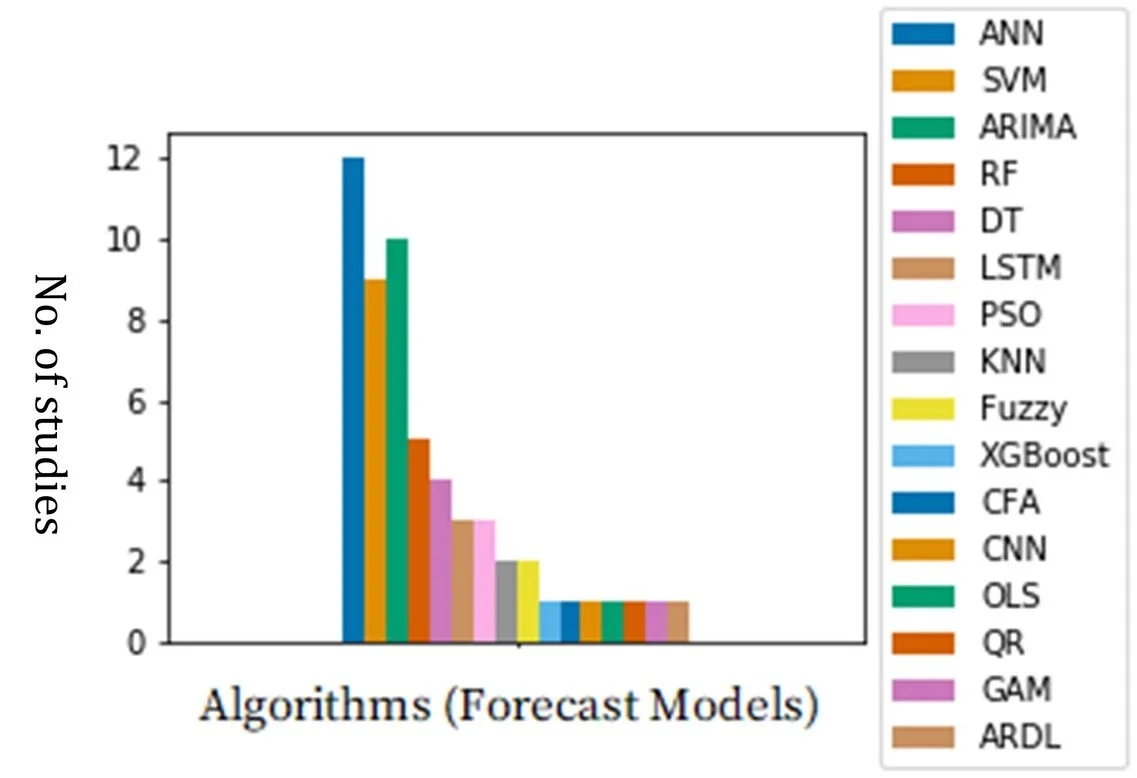
most used algorithms for electricity forecasting
Conclusions
The current study sought to reviewed state-of-the-art literature on electricity load forecasting to identify the challenges and opportunities for future studies. The outcome of the study revealed that electricity load forecasting is seen to be complicated for both engineers and academician and is still an ongoing area of research. The key findings are summarised as follows.
1.
Several studies (90%) have applied AI in electrical energy demand forecasting as compared with traditional engineering and statistical method (10%) to address energy prediction problems; however, there are not enough studies benchmarking the performance of these methods.
2.
There are few studies on EED forecasting in Africa countries (12 out of 67). Though the continent has progressive achievement in the creation of Regional Power Pools (PPP) over the last two decades, the continent still suffers from a lousy power network in most of its countries, leaving millions of people in Africa without electricity.
3.
Temperature and rainfall as an input parameter to the EED forecasting model are seen to have a divergent view. At the same time, some sections of research recorded an improvement in accuracy and reported no improvement in accuracy when introduced and input. However, the current study attributes this to the difference in automorphic temperature globally and the different economic status among countries. An additional investigation will bring more clarity to the literature.
4.
This study revealed that EED forecasting in the residential sector had seen little attention. On the other hand, Guo et al. [78] argue that the basic unit of electricity consumption is home.
5.
It was observed that there had been a global increase in residential electricity demand, this according to the report in [49] can be attributed to the growing rate of buying electrical equipment and appliances of low quality due to higher living standards. However, a further probe into Soares et al. [49] assertion will bring clarity to literature because of the discrepancy in opinions in literature.
6.
Lastly, the study revealed that there is a limited number of studies on load forecasting studies in Ghana. We, therefore, recommend rigorous researchers in this field in the country to enhance the economic growth of the country.
Our future study will focus on identifying the relationship between household lifestyle factors and electricity consumption in Ghana and predict load consumption based on identified factors since it is an area that has seen little or no attention in Ghana.
Current state of communication systems based on electrical power transmission lines
Antony Ndolo & İsmail Hakkı Çavdar
Journal of Electrical Systems and Information Technology
Abstract
Power line communication technology is a retrofit alternative technology for last mile information technology. Despite several challenges, such as inadequate standards and electromagnetic compatibility, it is maturing. In this review, we have analysed these obstacles and its current application status.
Introduction
Indeed, advancements in communication engineering and technology have brought in revolution in the telecommunication industry. One great impact has been in information and service delivery during the last decades of the twentieth century to date. This is due to the high demand for information created by the huge human population. Better methods and channel models for signal transmission have been researched and developed. For instance, fibre optics has provided waveguide for numerous services at higher speed while inheriting other advantages such immunity to electromagnetic interferences amongst others [1, 2]. Despite all the positive attractions towards fibre communication, it is expensive to install and it is limited to certain areas. That is, remote, rural and mountainous areas. This has necessitated the search for alternative information transmission methods. Power line communication (PLC) is one such alternative.
Power line communication technology is the basically a technology that uses pre-existing and installed electrical power cables for transmission of information [3,4,5,6]. Traditionally, such electrical lines were designed exclusively for distribution and transmission of electricity at lower frequency. This frequency varies from country to country, mainly, 50 Hz or 60 Hz. Upon generation of electricity, it is distributed and transmitted through different voltage network. Firstly, electricity is transmitted over high voltage lines, then distribution is done over medium voltage lines, and lastly, it is converted/scaled down using transformers for the end-user consumption in the low-voltage lines. Figure 1 gives summary of PLC structure. This technology is therefore retrofit and economically cheaper compared to other methods. There is no need for new cable installations. Secondly, electrical power network is the most developed, covers large areas and reaches many homesteads. At distribution lines, they are majorly used for the control signals, remote data acquisition and IP telephony services [7].
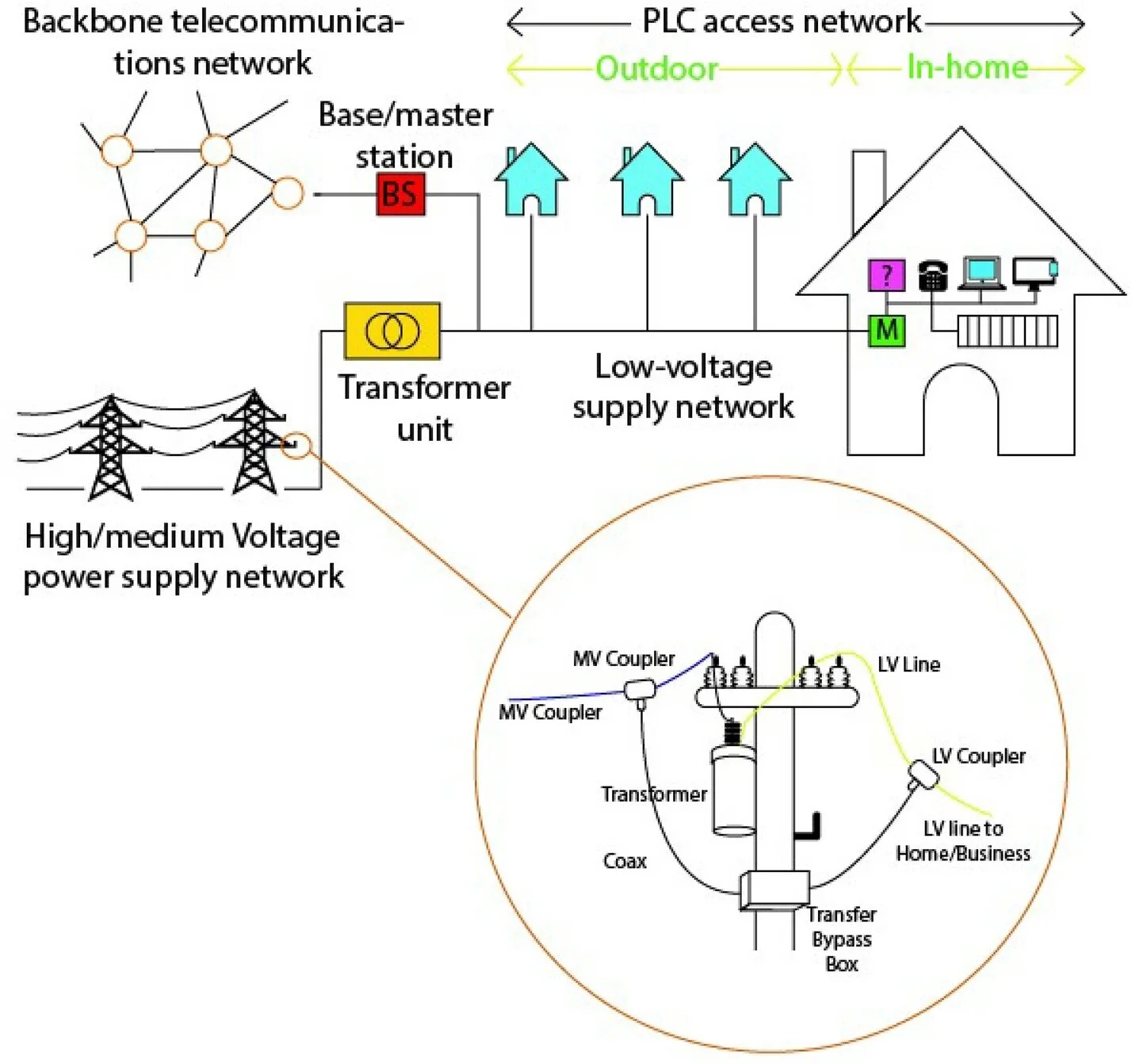
Structure of power line communication network
Power line communication is divided into three categories, namely ultra-narrowband, narrowband and broadband as summarised in Table 1. The first two are commonly grouped together and termed as narrowband PLC. We will characterise these categories in the next section in details.
Read more
Can vitamin C lower uric acid? A collection of popular medication questions!
Dingxiang Garden

1. Can vitamin C lower uric acid?
Yes.
Relevant literature shows that "vitamin C can reduce uric acid." The mechanism of action is: Vitamin C antioxidant effect can expand into glomerular arteriole, increase renal blood flow, thus increase glomerular filtration rate; Competition for tubular reabsorption.
2. What medications can be used to treat obesity?
Ciprofloxacin (naltrexone) / bupropion, lorcaserin, phentamine / topiramate, orlistat, liraglutide.
Currently, The main drugs approved by the United States Food and Drug Administration (FDA) to treat obesity are ciprofloxacin (naltrexone) / bupropion, lorcaserin, phentermine / topiramate, orlistat, and liraglutide.
But orlistat is the only drug approved in China with an indication for treating obesity. Orlistat for the treatment of obese and overweight (BMI ≥ 24 kg / m2) adults aged 18 years and over[1]。
3. How to choose anti-osteoporosis drugs?
Sub-situation selection.
Oral medications such as alendronate should be preferred in patients with low to moderate fracture risk. In elderly patients with oral intolerance, poor compliance and high fracture risk, such as multiple vertebral fractures or hip fractures, injections such as zoledronic acid and teripratide may be considered; Estrogen or selective estrogen receptor modulator such as raloxifene may be considered in patients with only a high risk of vertebral fracture but not hip and non-vertebral fracture. Short-term use of calcitonin may be considered in patients with new fracture and pain[2]。
4. What is the optimal route of administration of dopamine?
Administration via central venous catheter.
Dopamine is preferably administered via central venous catheter to eliminate the risk of drug extravasation. In the absence of a central venous catheter, bulky veins should be used for intravenous (intravenous) or intravenous drip (intravenous drip), while preventing drug extravasation[3]。
5. What is the preferred fluid for acute pancreatitis rehydration?
Isotonic crystal liquid.
Extracellular solutions (Ringer's Lactate, etc.) may be associated with anti-inflammatory effects, but evidence based on randomised trials is insufficient to demonstrate that Rlinger's lactate is superior to normal saline. Artificial colloids such as hydroxyethyl starch (HES) are not recommended due to increased risk of organ failure[4-6]. While correcting blood potassium levels.